This interview should have gone up a while ago but then Christmas went and got in the way... Thanks to Richard for being more prompt with his answers than I was at posting them! You can read my review of 'Kultus' over Here if you haven't read it already.
And now, on with the questions...
What has the reaction been like towards 'Kultus'? Anything like you were expecting?
I didn’t really know what to expect, but I did know, with this being a debut novel, that it wouldn’t be universally well received… and I was proved right! However, I’m quite pleased that people either seem to love it or hate it – ambivalence would have been the worst reaction of all.
The people who have loved it seem to do so for the right reasons, though. Kultus isn’t an in-depth character study, it’s a balls-out action-adventure set in a steampunk background and with a main protagonist who could rip your head off and crap down your neck – and most probably will. If that’s what you’re expecting before you read it, you won’t be disappointed.
Which came first, the city of Manufactory or the character of Thaddeus Blaklok?
Blaklok definitely came screaming fully formed from the depths of my imagination first. For me, novels always start with characters before anything else. For such an uncompromising character I needed somewhere for him to play that would be equally as challenging. So, like Judge Dredd has Mega City One and Batman has Gotham, Blaklok has the steam-fuelled hellhole that is the Manufactory.
Where did your inspiration for the story come from? Any influences or did this one just pop into your head?
The main seed for the story actually came while I was reading the last Harry Potter book (in fact for people with no frame of reference who’ve asked what Kultus is about I’ve said it’s kind of Harry Potter for grown ups). In the Potterverse there’s a group of wizards known as Aurors whose job it is to track down errant wizards who use the Dark Arts for ill. It’s suggested that the Aurors end up almost as twisted and violent as the evil which they’re tasked with stopping, and I thought this might make a great premise for a character. From this came Thaddeus Blaklok!
Is Thaddeus really such a bastard as you're making out?
Yes, most definitely. But perhaps he has hidden depths – you’ll just have to wait and see.
I loved the scenes with the Hellfire, did they come about after a hard night's curry eating?
Let’s face it, we’ve all had those nights – and sometimes it’s from both ends, though for me that was a rather nasty kebab meat pizza I ate, rather than a curry.
You've written a comic book introduction to Thaddeus Blaklok, will we be seeing any more of these and will they be included in future books?
Ryan E Horvath did a fantastic job of rendering Blaklok in comic strip form and I’d love for him to appear in more. In fact I’d love to explore other media for the character – I’ve often thought he’d be great in an anime movie. Let’s just wait and see.
What's in store for Thaddeus in the future? Answer in ten words or less...
Elastoplast and therapy. Well maybe not the second one.
What are you reading at the moment and why should we be reading it too?
I’m currently reading A Dance with Dragons by George Martin, which I’m sure needs no introduction, and I don’t think it needs me to tell people why they should be reading it either – pure epicosity!
And finally, someone is thinking of picking up 'Kultus' and you've got ten words (yep, that again!) to convince them to give it a go. Have at it...
It’s got the best Romantic Interlude you’ll ever read… sort of.
That was eleven words but let’s not quibble over it, eh!
Hmmm... Ok, I'll let you have that extra word now but an extra word will be taken off any answers you have to give to questions in the future ;o)
Cheers Richard!
(For more information, Richard Ford's website can be found Here)
Showing posts with label author interview. Show all posts
Wednesday, 28 December 2011
Thursday, 1 December 2011
Author Interview! Sarah Cawkwell
I had a lot of fun reading 'The Gildar Rift' (have a look at my review over Here) and, once I'd finished, found that I had a few questions that I would have loved to run past Sarah given half a chance. Well, not only did I get that chance but a whole load of answers came flying back; thanks Sarah!
Check it out...
In what’s becoming a question that I ask Black Library authors... Do you have your own army of Space Marines and (if so) did you use them to enact key scenes when writing ‘The Gildar Rift’?
I’m in the process of building my first full army. At the current rate, I might actually have a game-ready force by around 2017. My entire army presently consists of a Terminator Librarian and two-and-a-half Devastators. But you know. They could probably fight off a couple of angry squirrels.
I happily admit to using a couple of figures to block out certain scenes. More fun though was the blocking of the space battles. ‘This stapler is the strike cruiser… and this hole punch is the Wolf of Fenris, these pencils are…’ Things were swept off the desk and the battle of office stationery was waged.
I do something similar with my office stationery, the big difference though is that I'm not writing a book... On your blog you mention that you get to ‘write about super-human, 7ft tall, heavily armoured killing machines with BIG guns, bigger swords and a collective mental age of about 15’. How do you go about making an emotionally stunted post-human character someone that a reader wants to spend time with (when he’s not blowing stuff up)?
I enjoy creating characters that people feel something about. Whether that ‘something’ is sympathy, dislike, affection or whatever. Contrary to other people's beliefs, I don’t think that Space Marines are flat and emotionless. They fascinate me. Everything about them is exaggerated – and that includes the way they interact, particularly with each other. They're only flat and emotionless if you write them that way. Of course, there's always a need for 'red shirts'.
If you aren’t emotionally invested in your own characters whilst writing about them, you can’t expect readers to care about what happens to them. If I have a character I don’t enjoy writing about, I tend to assess their behaviour and try to make them start behaving the way I would want to read about them behaving.
There must be countless Chapters of Marines fighting their way across the Imperium, what led you to focus on the Silver Skulls? Can you see yourself writing more about this Chapter in the future?
I’d developed some stuff about the Silver Skulls alongside some friends on the old Bolthole forums and over time have grown very fond of them. My fellow forumites were very supportive of my pursuing getting some of our stuff into canon. Of course, some of the things that were originally developed were thrown out for being too radical and stringently anti-codex, but many other things have remained. Above anything else, I like the tribal, superstitious nature of the Silver Skulls.
I also like that they are going through a vital period of change in their history, a change that they may have left too late.
I’d definitely like to write more about them. There are too many characters in my head I want to give screen time to.
Huron Blackheart is a pretty major character in the Warhammer 40K universe. What was it like to have him stride around in your novel? Were there any constraints that you felt in writing about a character that may yet have a part to play in future books written by other authors?
It was wonderful. He took on a life of his own. Whilst I was writing The Gildar Rift, Aaron Dembski-Bowden was also completing Blood Reaver, so we spoke a bit about how our different realisations of the same character could marry up properly.
It was definitely a great honour to get hold of a character like Huron. There’s just something so immensely satisfying about being able to write for a character who is as mad as a box of frogs, but who still possesses the remnants of one of the most brilliant strategic minds ever.
‘The Gildar Rift’ ends with one particular story left unfinished (and it just had to be about the guy I was rooting for the most...), are you planning on tying up any loose ends in a future book?
I most definitely hope so. The character I’m guessing you are talking about is one who actually survived the original draft cull. He was scheduled to die somewhere around page 300, but I’d gotten too attached to him (see previous comment about investment in characters). So his over-arcing story changed completely during the process of storytelling.
I’m shamelessly stealing this question from my interview with Chris Wraight... You’re writing in a universe that isn’t just shared between writers but also between thousands (at least) of wargamers. How has this second group of people taken to your work so far? How does it feel to be the one depicting cities and even entire planets that have been fought over for years now?
Feedback so far has been brilliant. It’s an unnerving experience watching your first novel go out into the wild, particularly amongst an audience with as much enthusiasm and eagerness as the Warhammer fandom. I’ve been to several signing events now and without fail, people have been highly encouraging, having read one of the several Silver Skulls stories that have appeared throughout the ‘life’ of Hammer & Bolter. Now that the book has gone on more general release, with a full release very shortly, I’ve started getting a trickle of feedback. And it’s all been encouraging stuff.
I love this universe. I have researched and read until my eyeballs bleed and I am glad to be seen to be doing it some justice. If I can continue produce stories people enjoy reading… then that’s good enough for me.
If you could be any other Black Library writer, which one would you be and why?
Aaron Dembski-Bowden. Nobody can rock the beanie like that man.
Actually, every other one of the BL authors has 'something' going for them that I envy in one way or the other. But being fundamentally pragmatic, I'll just have to carry on learning from them - and believe you me, these folks are very generous with their time and advice.
Why should someone who has never picked up a Black Library book give them a go?
It’s too easy to dismiss Warhammer 40k and Warhammer Fantasy books as ‘just more tie-in fiction’. But the universes are both so stunningly unique. There is so little that’s meh… generic… about the fantasy/40K verses. For the most part, there is a great mix of character-led stories and high energy action set pieces. And they’re just plain fun to read.
The ‘Horus Heresy’ books are a pretty big deal for Black Library at the moment, have you got your eye on writing one in the future?
That’s the dream of any author who gets taken into the Black Library fold, I’m sure. It would be an absolutely brilliant opportunity should it arise and I’d leap at it. To be able to contribute to such a rich series would be amazing.
And finally, you have another Black Library book coming out next year, who is Valkia the Bloody?
This lovely lady is the consort of Khorne and one of the most notorious Warriors of Chaos of the Old World. She’s a former barbarian queen who has something of a penchant for doing things her own way and dishing out fast punishments to any who dare challenge her. After a bit of a heated discussion with a daemon prince of Slaanesh who suggests that she might be more suited to being one of his slave girls, she dedicates herself to Khorne and…
And lots of things happen… mostly involving blood, decapitation, pitched battles and all the other things you'd expect of a Champion of Khorne.
Thanks Sarah!
You can find out more about Sarah, and what she's up to, at her blog over Here.
Tuesday, 8 November 2011
Author Interview! Joe McKinney
I'm a huge fan of Joe McKinney's work (you knew that already though...) so it was a huge deal for me when he kindly agreed to answer a few questions here. Check it out and thank him when the zombie apocalypse finally happens...
Let’s get the obvious question out of the way first: Do you have a plan of action ready for the inevitable zombie apocalypse?
It’s happened to me more than once. I’m at some convention, doing the question and answer part of a panel discussion, and somebody up near the front says, “Man, I’ve got my bunker all set to go!” I’m not like that. I’m from Texas, yes, but I don’t stockpile weapons and ammunition, and I don’t have Old West-style visions of myself going nuts through a crowd of zombies, pistols blazing in both hands. But that said, I have been a police officer for a long time, and one of the best jobs I ever had as a cop was working in the San Antonio Police Department’s Emergency Operations Command, where I was in charge of imagining the various disasters, both natural and manmade, that San Antonio was most likely to face, and then working out the various ways the Department would deal with those disasters. Part of that training rubbed off on my home life, and so I completely understand the need for a family readiness plan, which of course includes a 72 hour emergency kit, food, water, cash, and yes, a pistol. I firmly believe in the message behind the recent Center for Disease Control’s Zombie Apocalypse Contingency Plan post: all the things you would normally put aside to help you prepare for the zombie apocalypse are also good for any other kind of disaster. So, whether it’s zombies, hurricanes, floods or wildfires, my family and I are prepared.
There are a number of writers of zombie fiction out there right now; are you worried that you might reach your place of shelter only to find that someone like Jonathan Maberry or David Moody is already there? What would you do if this was the case?
This doesn’t worry me too much. I’ve already made it a point to branch out into other paths, such as crime fiction and mainstream thrillers, and as I go forward with my career I see myself going deeper into those areas. The police procedural, for example, is a natural for me. You’ve seen that already in the zombie books I’ve done. I can, and will, go farther into that field than any of my contemporaries in the zombie genre are prepared to go.
You’ve carved out a neat little niche in the zombie genre. Was this always the plan or did you plan on writing other stuff originally?
Frankly, I was as surprised as everybody else with the surge in zombie popularity. I wrote Dead City with the idea that it would be a one-off, a fast and fun romp through a city overrun by my favorite member of the undead family. I was going to do the one book and then jump into crime fiction. But the zombie genre took on a life of its own, and I was fortunate enough to share in that. That said, zombies aren’t going to be so conspicuously popular forever. Right now, they’ve got the center stage. We have biologists talking about zombie worms, ants and cells; Nobel Prize-winning economists talking about zombie banks and mortgages; the protestors occupying many of America’s cities are dressing as zombies to illustrate their points; computer programmers talking of zombie computers and zombie viruses; the list goes on and on. A concept so thoroughly mated to a culture’s language is not going to go away. Zombies won’t always own the horror genre the way they do now, but they’re not going to disappear either. I’m prepared for that. I’ve already written in other genres, and as I continue to grow as a writer, I will of course pursue other paths.
Your books present a pessimistic view of our government’s ability to deal with an outbreak of zombies. Do you think we’d get it right if something like this happened for real?
Not even close. We’d all get munched in no time. Of course, now that I’ve said that, I guess it would really depend on the cause of the zombie outbreak, and where it happened. If it spreads like the flu, then no, we’re all going down hard. But if it originates in some remote corner of Africa, or at a research station in Antarctica, and the actual disease vector is spread through bites, then yes, there’s a chance we could contain it. The short answer though, well, if it’s anything like the movies envision it, I think we’d probably see something like ten percent survival rates for our species as a whole. Those who don’t get eaten will have to contend with complete shut downs in every aspect of our lives. Take just one example: prescription drugs. I don’t know about you, but I know a bunch of people who take blood pressure pills, thyroid medication, insulin, you name it. All that stops come the zombie apocalypse. And if you’re one of those people who depend on prescription drugs for your health, well, I’ve got bad news for you. You’ve just joined the ninety percent who die. And that’s only one aspect of health care. Think about everything else that would be so much worse without the safety net of a hospital.
But your question was more directed at our government’s ability to protect us, wasn’t it? In that case, no, we’re still screwed. Think of the most basic issue facing our cops, firefighters, hospital staff and military. These are the people we are going to depend on to pull our bacon out of the fire, to keep us alive. But these are people too. They have families, they have lives beyond their jobs. How long can any human being, any real human being, stay on the job knowing their family is about to get eaten by cannibals? That conflict between one’s oath to serve the public and one’s atavistic impulses to protect a spouse and children is at the heart of a lot of my zombie fiction; and you’re right that I take a pessimistic view of anyone choosing the ambiguous public over the very real loved ones waiting for them at home.
Your website talks about a story that doesn’t stop at Flesh Eaters; for those readers who haven’t visited your site (yet), what happens next?
I’ve always hated the conventional series, where you follow the same cast of characters through adventure after adventure. For me, the blush comes off the rose somewhere around the middle of book 2. So, when my publisher asked me to turn Dead City into a series, at first I resisted. But then I got to thinking that I had created a backstory in Dead City that could spin off into all kinds of new directions. I came up with the idea of making each book, short story and novella in the series use a different cast of characters to explore some aspect of the world where the series takes place. The basic premise is that Houston has been hit by four major hurricanes in just a few weeks. Millions of people are stranded. The city is underwater. Houston’s refineries are leaking chemicals and oil into the floodwaters, which are crowded with dead animals and people. Add to that the Texas summer heat, and you get the beginnings of an apocalypse that is eventually contained behind a quarantine wall. This is the story told in FLESH EATERS. DEAD CITY tells the story of a lone patrolman in the nearby city of San Antonio, where many of the evacuees from Houston have been relocated, on the first night of the zombie apocalypse. APOCALYPSE OF THE DEAD takes place two years after the events in FLESH EATERS and DEAD CITY, and shows what happens when the original quarantine wall collapses. There’s a fourth book in the series that I’m finishing up now called THE ZOMBIE KING, and that one takes place eight years after APOCALYPSE OF THE DEAD. THE ZOMBIE KING will explore how the zombie’s change over time, and will also answer some questions about humanity’s chances of long term survival.
The three books of yours that I’ve read all seem to stand well on their own. Which one would you recommend starting off with?
For those looking for zombie books, I recommend starting with FLESH EATERS. That’s the origin story, and establishes the world in which the rest of the series takes place. Though they can be read in any order, the most logical way to absorb the whole series would be: FLESH EATERS; DEAD CITY; APOCALYPSE OF THE DEAD; THE ZOMBIE KING. I’m also going to be releasing a collection of all my zombie short stories to date in March, 2012 called DATING IN DEAD WORLD AND OTHER STORIES. Many of the gaps between the novels will be answered by short stories within that collection.
How do you know when you’ve written something that will scare your readers? Does it have to scare you first?
I can tell when something is going to come across as terrifying when it makes me giddy while writing. There is a scene in FLESH EATERS, for example, where the main character is dangling from the edge of a roof while a horde of zombies waits below. I remember writing that scene at a fever pitch, my eyes wide open and unblinking, chuckling to myself. At some point my wife walked into my office and cleared her throat and I nearly jumped out of my chair. So, yeah, I guess the good stuff has to scare me first.
For those readers yet to try zombie fiction, what books have you enjoyed recently?
God, there’s a bunch. Let’s see, here’s a short list: Philip Nutman’s WETWORK; Brian Keene’s THE RISING, CITY OF THE DEAD, and DEAD SEA; John Skipp’s BOOK OF THE DEAD; John Joseph Adams’ THE LIVING DEAD 1 and 2; Alden Bell’s THE REAPERS ARE THE ANGELS; Jonathan Maberry’s Joe Ledger series, especially PATIENT ZERO and his two YA zombie novels, ROT & RUIN and DUST & DECAY; Max Brooks’ absolutely amazing WORLD WAR Z; Iain McKinnon’s REMAINS OF THE DEAD and DOMAIN OF THE DEAD; Peter Clines’ EX-HEROES; the Marvel Zombies series of graphic novels; David Moody’s AUTUMN series; Robert Kirkman’s THE WALKING DEAD graphic novels; Mason James Coles’ PRAY TO STAY DEAD; Stephen King’s PET SEMATARY; Kim Paffenroth’s DYING TO LIVE; J.L. Bourne’s DAY BY DAY ARMAGEDDON...God, the list could go on forever. There’s so much more than what you see on TV and in the movies. So much more.
And finally, what is your number one rule for surviving the zombie apocalypse?
Teamwork. No matter how much of a badass you may be, there’s some zombie out there with your name on his teeth. You want to stay alive, learn to work together. Get a group that, between them, has mastery of as many basic survival skills as possible, and learn to live together.
(Joe's website is in the sidebar on the right, pay him a visit...)
Saturday, 24 September 2011
Author Interview! Andy Remic
After finishing 'Vampire Warlords', I knew the time had come to corner one Andy Remic in his lair and put him to the question... Upon arriving at Andy Remic's lair though, I found that Andy was only too happy to be put to the question and would probably have offered tea and cakes if we had been doing this in person :o) Here's what he had to say for himself...
Kell is your homage to Druss the Legend, after three books would you say that Kell has said everything about Druss that you wanted him to?
Indeed, I started off writing Kell’s Legend as a homage not just to Druss the Legend, but to David Gemmell the author, a man I very much respected and admired. I still remember finding out that David had died, and like many other fans across the globe, it was a blow to the heart. The writing of Kell’s Legend was meant as a kind of repayment. I wanted to say thank you. I wanted the spirit of Druss, and Dave, to live on a little longer. However, the more I wrote about Kell, the more he (as all characters will do) pulled away in his own discrete direction until by the end of Vampire Warlords, the third book in the Clockwork Vampire Trilogy, you are very much in no doubt that Kell is not Druss; he is his own man, his own dark soul, and a fantasy character in his own right.
I still can't believe this one... Tell everyone what you told me about where all the swearing etc in 'The Clockwork Vampire' Chronicles came from...
Heh, I couldn’t do that..... What, a double whiskey? Oh go on then.
Kell’s Legend was originally written as a “straight” fantasy, in that it didn’t use contemporary bad language. However, editorial guidance suggested I might want to make it a little more harsh and violent and exciting, which I was happy to do. So, when yon amateur critic bemoans a use of the “F” word in a novel, please be aware that sometimes there isn’t just the writer to blame; editors and publishers like their blood and gore red, and their cusses manly, you know.
Do you think that the overall affect hit the target that your editor was aiming for?
My editor (Marc Gascoigne for the first Kell book) is a very astute editor and publisher, and indeed knows the marketplace like the back of his hand. He was well aware of what writers such as Abercrombie, Morgan, and indeed George R. R. Martin were up to (seeing as I sometimes live hermetically sealed in a bubble), and he gave me a kick to up my game - into the same playing field as my contemporaries. Some people will like the books as they are, some will bemoan the language. You can’t please everyone, dear boy.
And you shouldn't have to either :o) Will we see other tales set in Kell's world that don't involve him or is this setting all about Kell?
No. This is Kell’s world, and his alone. I have another six books (two discrete trilogies) planned for Kell and Saark, but have not yet put them on paper, or indeed approached publishers. So yes, they are in my head. But no, there are no contracts in place.
Is Kell the kind of guy that you could see yourself having a few whiskies with?
Oh yes. And I have. We’ve got drunk together several times around the fire, shared tales about war wounds and evil, and discussed the pleasure in wielding a finely balanced axe. Often is the time I chat with characters in my head.
For those readers who haven't picked up the 'Clockwork Vampire Chronicles' just yet, what will these books give them that no other books can?
The actual race of the Vachine, or “Machine Vampires”, are a unique creation – as has been commented on by many critics. They are based on a clockwork technology that requires a distillation of blood (blood-oil) in which to lubricate the machine parts, thus rendering the Vachine vampiric by necessity of survival. And then we have Cankers, the twisted deviations of the Vachine. And then we have Harvesters, who drink blood and souls through their hollow bone fingers.... and amidst all this we have excessive slaughter, fast-paced action, twisting plots, black humour and banter between Kell (grumpy old man) and Saark (womanising dandy). It all makes for a pot of wholesome adventure goodness, I think ye will agree.
It worked for me! You strike me as a writer who has plenty on the go so... what else do you have on the go right now writing-wise?
I’ve just finished a very straight fast-paced thriller SF novel for Solaris Books called Theme Planet. It is, I believe, one of my finest moments. And I’ve just published SIM under my own little digital label, Anarchy Books, about a mad killer cyborg. With a pussy cat.
Talking of which, what's all this I'm hearing about Anarchy Books? What's all that about?
I'd written a couple of novels which were not of my "genre" (SFF) and, like every other author, have seen the gradual acceleration of digital publishing during the last couple of years following in the footsteps of the digital music world; and I thought, "why the hell not?" I knew some of my books were doing well digitally, and simply decided I'd give it a try as a vehicle for some of my different genre works. Then I discovered other friends/writers wanted to jump onboard as well, hence Anarchy Books! Ultimately, I suppose it's my long-term backup plan for when I've sexually offended every single publisher I've ever worked with, and they all lock me out of the Big Boys Club and in a dark dungeon filled with chains and torture devices. Kinky, these publishing types, y'know ;-).
At the back of 'Vampire Warlords', you mention that you're friends with Ian Graham, what's he up to these days? I haven't seen anything of him since he wrote 'Monument'...
Ach, Ian and I are very, very good friends. We regularly partake in what we call The Stinklings where we critique one another’s ongoing projects. Ian wrote a second novel called Blood Echo, but decided to hold it back because he wasn’t happy with it. Never have I met a man so obsessed with perfection, to his very great personal detriment. He’s so perfect he manicures his leg hairs. Anyway, he has indeed now finished a true successor to Monument (which I have read in various drafts, ha! the benefits of being friends with another author) and it is truly dazzling. I mean, really really great. It’s just going through final tweaking at Orbit, I believe.
And as for Ian’s Monument? Well, still fine and erect, I believe. *cough*. And he trains leeches with it now, y’know.
And finally, what are you reading right now and why should we avoid it at all costs? (Other interviewees get this question the other way round but I think you can handle it...)
I’m currently reading The Truth by Terry Pratchett. I am a big Pratchett fan, having worked my way through several of his early novels whilst sat in Fifth Year Geography at school [age 15], surreptitiously hiding them behind my textbooks on glaciers and deforestation. I got an E grade in Geography. And I applaud Terry for that. The Truth is a good book, scarred by the inclusion of Mr Pin and Mr Tulip, a parody on, it would seem, Jules and Vincent from Tarantino’s Pulp Fiction. This inclusion, this parody, is just wrong. It kicks me in the groin every time I come to another section with Tulip and Pin, and their very annoying “-ing”. However, the concept of the novel as a whole is great, and as usual, Pratchett delights in the absurd, the cleverly worded, and the intelligently baffling.
Thanks for taking time out to do this, I owe you one :o)
Tuesday, 30 August 2011
Author Interview! Drew Magary.
What kind of guy writes a book where immortality can give the term 'Peter Pan' a nasty new meaning and nano-technology leads to the immortal armies of the world being more interested in eating whatever is in their path rather than shooting it? That guy is Drew Magary, author of 'The Postmortal' ('The End Specialist' if you're in the UK) and I got to ask him a question or two; here's what Drew had to say for himself...
Lets get the obvious question out of the way first, would you take the cure if it was offered to you?
Hell yes. I'm getting older and I have all kinds of back pain and shit. No chance I'd ever want to get older. I know everyone getting it would be bad, but I can't SEE that now. I know drinking is bad for me, but that damage isn't immediately visible to me. So I do it. Same with this.
What led you to write ‘The Postmortal’? By this, I guess I'm asking what led you to writing about things like a mother condemning her daughter to eternity as an eight month old baby...
It was really just a simple idea, espoused in the title of the first chapter. If we all lived forever, we'd all end up pretty pissy with one another. So I tried to play that out to the last detail. Some of it gets pretty hairy, but it wasn't because I'm some weird goth kid. I just try and go where the idea leads.
‘The Postmortal’ shows it’s reader only too clearly that humanity isn’t ready for eternal life, at least not as far as you’re concerned. If the cure was available in real life though, do you think that any good would come out of it at all?
Oh, most definitely. Seniors account for pretty much all the health care expenses here in the US. If no one got old, it wouldn't cost as much to go to the doctor. And everyone would look AWESOME.
You sold it to me! Your vision of an immortal future is pretty bleak to say the least; did you find yourself having to dial the bleakness back at all or did you just go for it?
I had an original ending that was, hard to believe, darker than what's there now. Then my agent was like, "No. Don't do that." And I didn't. I tried to temper everything with humor, but the idea is just naturally a dark one. It couldn't be helped. I just did my best to keep it as entertaining as possible right to the end.
Did you know all along that your vision here would be a bleak one? Did you ever toy with the idea of having immortality as something that is beneficial and all good?
Nope. It was all bad from the get-go. It was just more fun to have it devolve into mayhem. Happiness and order aren't very compelling.
I have to ask, what did you do to cheer yourself up after writing such a pessimistic book?
I never really got down while writing it. I was fairly clinical about what would happen and how it would happen. It wasn't so much that it was bleak to write, but it was fairly intense to write. I'd spend a lot of time in my own head space and would leave the tea kettle boiling and shit. At the end of the day, I'd feel pretty exhausted mentally. But it was a good feeling, like after you spend a day doing housework or something shitty. You feel like you earned your beer.
The science behind the cure is detailed enough to be plausible but vague enough so that people can’t poke holes in it. How difficult was it to get the balance right?
I've watched enough TV and movies to know how to bullshit it so it sounds good despite it all being total bunk. I did some research to get terms right, but I didn't go all Method Writer and spend eight years in a medical library.
Talking of science, 'The Postmortal' naturally focuses just on scientific developments arising from the cure. I know this is outside the book but do you think at least one scientist used his immortality to come up with something worthwhile? I'm still feeling depressed after reading the book (in a good way), cheer me up?
Don't be depressed. Consider this: If science and the eventual advent of advanced artificial intelligence can make us immortal, think about how that same collective brain power can help solve other problems like energy shortages and overpopulation. Because it can and it may. Also, I'm real sorry I depressed you. I wanna buy you a meat pie or something.
Funnily enough, I could really go for a meat pie round about now... You write in a number of other fields, are we likely to see more science fiction from you in the future? I’ve got a feeling that there won’t be a sequel to ‘The Postmortal’...
Nope, but there likely will be more social sci-fi from me.
And finally, why should we all be picking up ‘The Postmortal’ and checking it out?
Because you'll be making my ass money. And because the book is fucking METAL.
Good answer there Drew, honesty pays... ;o)
If that hasn't convinced to go and pick up 'The Postmortal' then have a look at my review over Here. Do check the book out though, I promise you it's worth it.
Tuesday, 28 June 2011
Author Interview! Gary McMahon
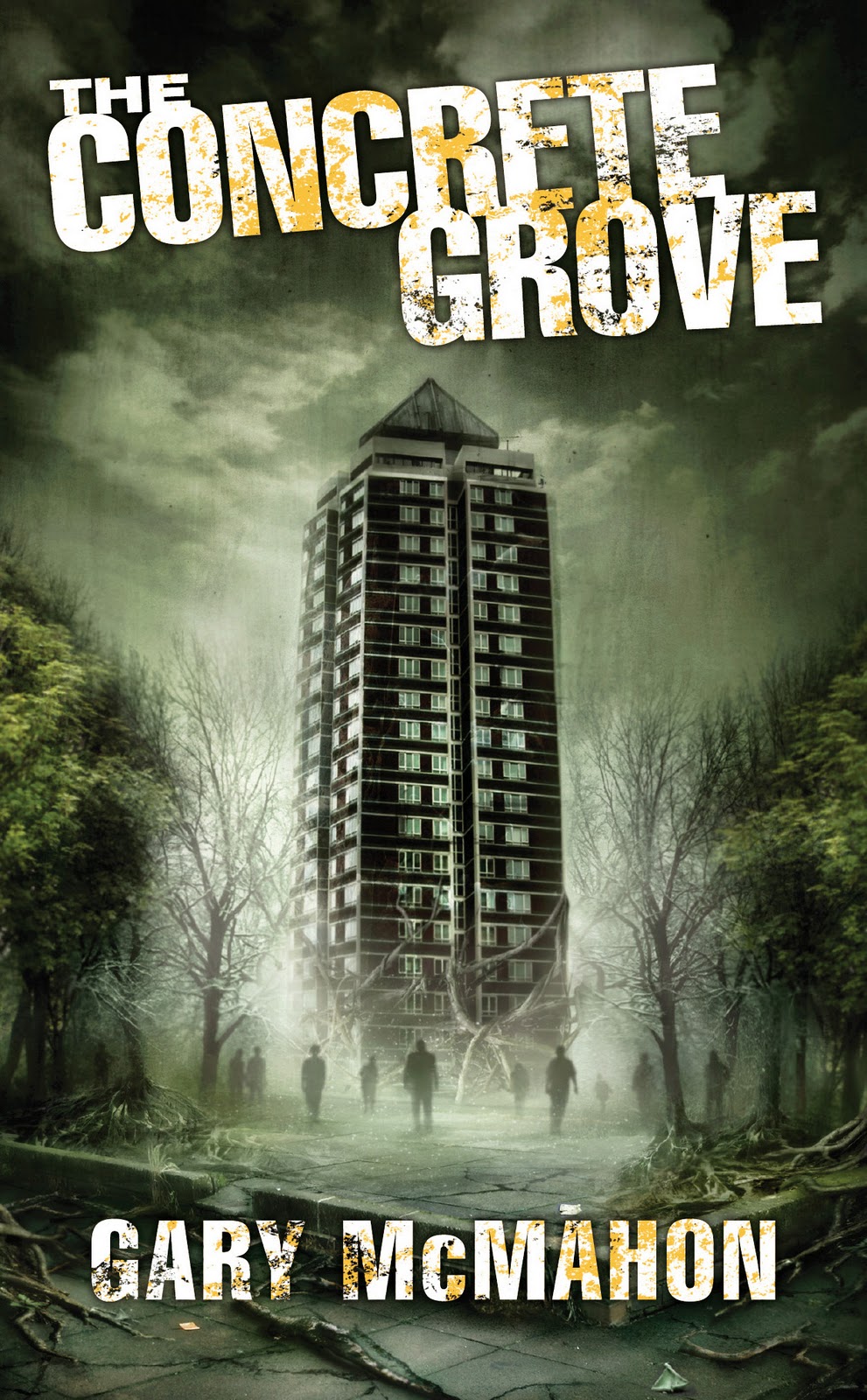
I reviewed 'The Concrete Grove' a couple of weeks ago; you can either click Here for the review or just take my word for it when I say that it's an exceptionally fine slice of horror fiction and you should read it if horror is your thing. Either's good :o)
Once I finished the book I found that I had some questions that I wanted to run past Gary; I also found that Gary is a very obliging fellow who was happy to answer whatever I threw at him. Thanks Gary!
Anyway, without further ado, here's what Gary had to say for himself...
‘The Concrete Grove’ is pretty intense in places, where did that leave you once you had finished writing the book? Did you need to take time to recharge your batteries or had you already thrown yourself into your next book?
I must admit, after finishing the novel I felt emotionally and mentally drained. Writing novels to a deadline really takes it out of me, and generally involves a lot of late nights and prolonged periods of insomnia because I only have the time to write at night. I tend to throw everything into my writing – I can’t just dip in and out of a project. Every writer is different, and that’s just the way I work. I take it all so bloody seriously, too, as if my life depended on it. I’m way too intense, so can never relax when I have a project on the go. Unfortunately, I always feel blocked for a little while whenever I finish writing a novel, and that’s cut into the time I have for the next one. So, yeah, I was knackered. Still am.
How do you know when you’ve just written something that will really unsettle your readers? Do you scare yourself with what you’ve written?
Usually, if I feel disturbed I tend to think that someone else who’s reading the thing might also be disturbed. There are a few scenes in The Concrete Grove, for example, where I felt genuinely ill at ease as I wrote them. But that’s my philosophy when it comes to writing horror fiction: if you write about your own fears, then hopefully other people out there will share those fears and the book will resonate with them. It’ll never get me an international bestseller, but if I’m lucky it might just win me a few loyal fans.
Horror fiction isn’t covered enough online, at least not on the blogs that I read. Which horror writers would you recommend to the readers here?
Ramsey Campbell is the best there is. Read him; read him now. Then read him again. King and Straub are masters. Other than these legends, my favourite horror writers tend to be people like Graham Joyce, Conrad Williams, Simon Bestwick – writers with a personal vision they are trying to communicate through their work. There are lots more I could mention, but I don’t want to use up my word count by listing names and then feel bad that I’ve missed someone off. Contrary to popular belief, there’s a lot of sensational work being done in the horror field. It’s just a matter of diving in and exploring what’s out there, and trying to avoid the bad stuff.
For the person who has never read any of your work, is ‘The Concrete Grove’ a good place to start or would you point them somewhere else first?
I’d say that either The Concrete Grove or Pretty Little Dead Things (my previous novel, published by Angry Robot) are the best place to start. They’re very different novels, but both are representative of where I’m at, and where I’m coming from and heading towards, with my work. I’m also very proud of my first mass market novel, Hungry Hearts (published by Abaddon Books back in 2009) – a nasty little zombie novel with a heart of stone.
You’ve said that the idea behind ‘The Concrete Grove’ has been with you for years but it’s only now that you’ve felt able to put it to paper. Did that idea end up evolving over time or is it essentially the same idea you had all those years ago?
To be honest, the story has changed and evolved so much that it’s now something completely different to how I first envisioned it when I was sixteen. The estate used to be called Wishwell, and was built over an ancient stone well. The location was originally going to be an area of concrete high-rises, and the story involved very 1980s themes, like joyriding and football hooliganism. I was never quite sure what the forces at work within the estate were meant to represent, but finally a couple of years ago I had an imaginative breakthrough and everything became a lot clearer. Oddly, the global recession helped focus my ideas about what it was I wanted to say, and I wrote a short story called “Owed” which became the heart of the first novel in the series.
I was probably having a bad day at the office but I couldn’t tell whether ‘The Concrete Grove’ was primarily fantasy or horror ;o) Do you see it as primarily one or the other? Or do you think that I’m making a meal of this and should just enjoy reading the book?
It’s both, fantasy and horror – also, there are elements of crime fiction thrown into the mix. And, yes, you should just read the book for what it is. In my mind, all these genres can blend and cross-pollinate. I have a very broad definition of the word “horror”, and I try not to let other people’s perceptions (or misconceptions) of the genre define what I write. It’s all horror to me.
‘The Concrete Grove’ offers up horror from both sides of the fence; the darkness that lives in us all versus the darkness that exists at the corner of our eye. As a reader, which source of horror scares you the most? As a writer, did you find yourself having to lend extra emphasis to the less scary source in order to make things more balanced?
I’ve always like the clash of internal and external forces – haunted people colliding with a haunted place. That’s where I’m most comfortable, exploring the emotional cracks and fissures caused by this kind of set-up. I’ve discovered that I’m also very comfortable writing about scumbag people – I love to examine horrible characters, and because of this the crime and social elements of the novel came easily. For me, as both a reader and a writer, I need my fictional horrors to be grounded in reality. It scares me more that way; I think the juxtaposition creates a lot of tension and anxiety in a story.
‘The Concrete Grove’ is the beginning of a trilogy but the blurb for ‘Silent Voices’ suggests something a little more standalone. Are there any connections to the first book, other than the Concrete Grove itself? Or is ‘Silent Voices’ the kind of book that you can jump straight into without having read the first book?
I’m writing these so that anyone can read each of the books as a stand-alone story, but you’ll certainly get more out of them by reading the novels in order. The stories are connected by the Grove estate, and specific characters have a bearing in all three books. I initially envisioned these three books as being structured like Jimmy McGovern’s brilliant television show The Street, where each week there was a different story about a resident on a particular street, and characters would flit in and out of each episode. Hopefully this method adds texture and richness to the project as a whole, but readers can take or leave these elements as they wish.
The cover art for ‘The Concrete Grove’ captures the atmosphere of the book perfectly. As the writer of the book, how much input did you get into the creation of that cover?
I’ve worked with the artist, Vincent Chong, on several projects in the past, so we have a great relationship, a kind of artistic simpatico. I was very involved with the cover – the basic image of the tower block with tree roots snaking around its base came from me and Vinny ran with it. We then batted ideas back and forth, and the image developed into what you see now. Vinny’s done the covers for all three books, and they’re exceptional...really breathtaking stuff. I just hope my prose lives up to his amazing artwork!
And finally, a flat has just become available on a housing estate where ghostly stuff happens on a daily basis and an encounter with the local loan shark could cost you far more than just the contents of your wallet. Would you recommend that flat to someone or would you tell them to go back and live with their parents until things pick up?
Ha! I’d recommend staying with Mum and Dad. A least you’ll get your washing and ironing done. And you won’t get blood on you.
Tuesday, 8 March 2011
Author Interview! Conrad Williams
I had a great time reading Conrad Williams' 'Loss of Separation' last week (scroll down a little bit for the review or just click Here) and wanted to run some questions past Conrad for the blog. Despite having loads on, Conrad was good enough to pretty much drop everything else and give me some answers (thanks!) Have you ever wanted to know how a horror author knows when they've written something scary? Does Conrad really think that the Suffolk coast is as grim as it is in the book? Read on...
Hi Conrad, thanks for agreeing to answer a few questions,
• Having written ‘Loss of Separation’, can you see yourself getting on a plane anytime soon?
I’ve always been a nervous flyer. I’m a terrible rubbernecker, and can’t not watch programmes such as Air Crash Investigation or Seconds From Disaster. I have a folder at home labelled Air Disasters. I read the NTSB reports… That said, I’m getting better where flying is concerned. I find a Valium washed down with a double G&T does wonders. Off topic... I love the cover to the novel, but I’m not sure if we’ll do any business in the airport bookshops.
• ‘Loss of Separation’ is the third book of yours that I’ve read but the first that ends on an optimistic note? Why the change?
I’m not sure. Possibly I’m getting soft in my middle age. In the original plans, everyone died. Maybe I just wanted to pull the rug from under the feet of those readers who think they know what to expect from a Conrad Williams novel…
• What was harder to write about in ‘Loss of Separation’, supernatural terror or the everyday terrors faced by a man who has had major surgery and woken from a coma?
For me, the supernatural terror came out of the mundane difficulties Paul Roan has to face. I wanted the ambiguity to be there – is The Craw, for example, real, or is it something that has developed like a tumour inside Paul? Is it Paul’s injuries manifesting themselves? It was hard to write about a man who has been reduced to such an extent and then has to grow, develop, recover enough to find the physicality to achieve what he achieves at the end of the book.
• Did a particularly grim holiday on the Suffolk coast inspire the setting for ‘Loss of Separation’?
Not at all. I love Suffolk. I spent a very happy six months there with my wife when we had first started seeing each other in 2000. We spent a lot of time walking on the beach, eating fish, drinking ridiculously strong Bloody Marys and writing. We were both writing for ten hours a day sometimes. I wrote Decay Inevitable while I was there. And I also came across an article in the Guardian that gave me the idea for Loss, although back then I always intended to call it Consummation. If I’d still been in London when I read the article, Loss might well have been a novel set in the city.
• You write some pretty intense stuff, where does that leave you once you finish writing a book? Do you take time to recharge your batteries or have you already thrown yourself into your next book? Do you know what your next book will be about?
I was pretty frazzled at the end of this novel. It was partly because the book had such a long gestation period. I must have started writing it three or four times since I got the idea, but it was only recently that it pushed to the front of the queue. I tend to switch on to something new shortly after completing a novel. At the moment I have three or four short stories I’ve been commissioned to write, but at the back of my mind I’m asking myself what the next novel should be. I’ve got half a dozen ideas, but I’m not sure which one to go with just yet. I don’t have any publishing deals at the moment, and I’m between agents, so the only pressure is from within. I think I’ll take a break and see where I’m at in the summer.
• How do you know when you’ve just written something that will really unsettle your readers? Do you scare yourself with what you’ve written?
That’s a good question. I suppose it’s just hopefulness. You try to write to the best of your abilities and hope that something good comes of it. Sometimes you write quickly, almost without thinking. Automatic writing, of a sort. It’s as if the work has controlled you, rather than the other way around. That’s often a sign of good stuff. I’ve unsettled myself on a few occasions. But there was a scene set in the Underground in The Unblemished that made my flesh creep while I was writing it; pretty much the only time that has happened to me.
• Horror fiction isn’t covered enough online, at least not on the blogs that I read. Which horror writers would you recommend to the readers here?
Those who write on the margins of horror, I find, usually produce work that is almost unbearably frightening. China Miéville (The Tain), M John Harrison (The Ice Monkey, The Course of the Heart), Christopher Priest (The Glamour, The Prestige), Nicholas Royle (The Matter of the Heart, The Director’s Cut).
• And finally, can you describe ‘Loss of Separation’ in ten words or less to readers who are thinking of picking it up?
Wicker Man meets Blair Witch meets Fatal Attraction
Thanks again!
Wednesday, 29 September 2010
A Quick Question About 'The End of the Line'
I use the Underground pretty much every day (go to work, come home from work... and repeat) and I guess I’ve become far too used to it over the years for it to scare me in any way. In fact, I’d go so far as to say that the scariest thing about the Underground is watching commuters (who are obviously running five minutes late to wherever they are going) literally throw themselves through the doors as they are closing. I fully expect to see someone chopped in half before the year is out...
That’s pretty much it for me though, the Underground just isn’t that scary. Or is it? Solaris editor Jonathan Oliver seems to think so as his name sits proudly on the front of ‘The End of the Line’, a horror anthology where the stories all share one theme; what’s lurking on the tracks that lie beneath our feet. I’m saving my review copy to read next month (Halloween and all that) but in the meantime I thought I’d go straight to the source and ask the following question...
'I use the underground everyday and I'm here to tell the tale. What's down there that's so scary?'
Jonathan Oliver was kind enough to take time out of his schedule for a reply and here it is...
I don't use the Underground every day. I don't get into London that often, but I used to go a lot when I was a stand-up comic. Usually gigs would go on quite late and I'd have to catch the last Tube. This would see me standing on the platform alone often as not, listening to the distant rumbling getting closer and closer, while feeling the brush of the warm wind rushing out of the darkness of the tunnel. There's something eerily atmospheric about the Underground, and I've often thought that it's criminally underused in horror fiction. There are a few examples (well, more now since we've published The End of The Line) I can think of, such as Deathline, the scene in the Underground in American Werewolf in London, Creep, Neverwhere, but there you see most of those are films, rather than prose. So, the idea for Underground horror has been in my head for quite a while, so when we decided to launch an anthology of horror fiction, this seemed to me the perfect theme. I was so pleased with how varied the stories we got were. These aren't just 19 ghost stories set on the Tube. Instead we have journeys within the characters themselves, as well as on the rails. There are brilliant ghost stories such as Christopher Fowler's 'Down', but there are also stories about impossible destinations (Michael Marshall Smith's 'Missed Connection'), a past love brutally re-visited (Paul Meloy's brilliant 'Bullroarer') as well as more lyrical stories about loss ('All Dead Years') and the paranoia induced by this error of terror (Ramsey Campbell's 'The Rounds). And these are just a few of the treats you can find here.
So what's down there that's so scary? Well, according to my authors, oh so very much. Where do you want to start?
I’m up for being persuaded that there could well be spookiness on the Underground after all, especially when Jon reminded me of ‘American Werewolf’ (that bit was scary!) I’ll be reading ‘The End of the Line’ sometime next month (you should be able to pick it up around the end of October or beginning of November) and will be sure to let you know if it lives up to its promise...
Thursday, 26 August 2010
Author Interview! Chris Wraight

Isn't the internet great? There used to be a time where if I enjoyed a book there wan't much more I could do after I'd read it other than think, 'that was a good book'. These days though, if I enjoy a book then I can chat to the author online and run a whole load of questions past them. Everyone wins (but mostly me)!
After having enjoyed 'Sword of Justice', the power of the internet gave me the chance to run a few questions past Chris Wraight. Here's what we had to say for ourselves...
You write in both the Warhammer and Warhammer 40K game settings, which one do you enjoy writing in the most?
Until now I’ve been exclusively a Fantasy author, so that’s the setting I feel most comfortable in. That said, I’m writing my first 40K book at the moment, and it’s been a huge - and fascinating - challenge. There are definitely some things about 40K that are very different - the darkness of the far future has the advantage of truly epic scale, and (arguably) a more consistent vision and tone. There are some BL authors who write for both settings (Graham McNeill, for example), and if the editorial gods will it I’d be happy to do the same.
How did you get into writing for the Black Library?
I submitted a short story to one of the old writing competitions, which ended up being published as Premonition in the Warhammer Invasion anthology. An invitation to pitch for a debut novel followed. I wrote Iron Company for the Empire Army series in 2009, after which BL invited me to pitch for the new Warhammer Heroes line.
What projects have you got coming up and why should someone who has never picked up a Black Library book give them a go?
Sword of Vengeance, the sequel to Sword of Justice, has just had its final edits sent in. I’m now over halfway through the Space Marine Battles book Battle of the Fang, which features the Space Wolves and Thousands Sons duking it out on Fenris. Like Rynn’s World, a previous title in the series, this part of the background has existed seemingly forever, so it’s a privilege and a challenge to take it on. I’m currently talking to the BL guys about a third Warhammer Heroes title featuring Volkmar, so the chances are I’ll be back writing Fantasy soon.
In terms of BL books in general, I’d simply encourage anyone with an interest in mainstream Fantasy or SF to give them a read with an open mind and not worry about whether they’re licensed works or not. There are authors writing for BL who are as talented as any in the business, and with Empire winning the Gemmell Award and the Heresy titles consistently entering the bestseller lists, the dismissive response of ‘but they’re just tie-in books’ looks lazier than ever.
In the same vein, what are you reading right now and why do you think I should be reading it too?
I’ve just finished Year of the Flood by Margaret Atwood, which didn’t quite hit the heights of the brilliant Oryx and Crake for me, but was still interesting and characteristically well-written. I revisited Legend a few days ago, which needs no recommendation, and have recently started Warrior Priest by Darius Hinks, which is due out later this year. It’s very immersive, and steeped with the gritty details that make Warhammer stand out from lighter, more optimistic Fantasy worlds.
You’re writing in a universe that isn’t just shared between writers but also between thousands (at least) of wargamers. How has this second group of people taken to your work so far? How does it feel to be the one depicting cities and countries that have been fought over for years now?
That’s a good question, and probably the thing that gives me most sleepless nights as an author. Sword of Justice has had a fantastic reception in its first few weeks, including from review sites that also cover the gaming side of things. The feedback I’ve seen so far indicates that the ‘feel’ of the established setting has been faithfully reproduced, which is immensely satisfying. One of the unresolvable issues of writing for a big franchise such as Warhammer is that you’ll never please everyone, since each individual will have a slightly different take on the universe, but you can do your best to capture the essential qualities that make it unique.
There are established characters from the Warhammer universe (I’m thinking Schwarzhelm and Helborg here) whom I’m guessing are almost sacrosanct in that you can’t kill them off easily if at all. How does that affect the writing process for you?
That’s the challenge of writing licensed fiction. There are lots of things that as an author I can’t do - certain people can’t die, certain places can’t be destroyed, and the balance of power in the Old World has to remain basically the same once the battles are over. In response to those limitations, you have to find different ways to generate jeopardy, interest and uncertainty. Characters have to be sufficiently well-rounded to draw the reader in and suspend disbelief, and you have to find fresh ways to treat long-established ideas. In Sword of Justice I was able to make use of a situation that’s been a longstanding facet of the background - the undetermined succession in Averland - which opened up lots of fictional possibilities.

Was it just me or is there a lot of Druss the Legend in Ludwig Schwarzhelm? I’m not just thinking about that amazing beard either...
You’re not the first to point out Gemmellisms in Sword of Justice. Druss wasn’t explicitly in my mind when I was writing Schwarzhelm, but of course there are a lot of similarities in their situations. In a broader sense, Gemmell is such a dominant figure in ‘low’, military-based Fantasy - which Warhammer basically is - that comparisons are probably inevitable. I’ve taken them as compliments.
Without giving too much away... There are four Chaos powers, what made you choose the one you did to infest Averland?
I chose the one that Schwarzhelm - a straightforward, noble, and in some ways naive warrior - would have the most trouble understanding. That’s really the whole point of the book: taking a man who’s almost unbeatable in a plain fight, and putting him up against opponents with a very different set of values and characteristics. To my mind, Chaos is at its most insidious and impressive when it preys on the weaknesses of mortals and turns their strengths against them.
I have to ask this... Are you a Warhammer gamer and, if you are, do you use the figures to act out battles from your books?
No, not a gamer I’m afraid. And having just finished writing battle scenes with armies of several thousand soldiers in them, acting them out would be very expensive...
If you are a gamer, how do you fancy painting my ‘Lord of the Rings’ figures for me? ;o)
You really wouldn’t want me to do that. The results would be... unfortunate.
If you could be any other Black Library writer, which one would you be and why?
I’m in awe of Dan Abnett’s ability to place memorable characters into taut, fast-paced action stories and make the end product so satisfying. As preparation for writing Battle of the Fang I read lots of his stuff, and it was a mixture of terrifying and inspirational. That said, there’s a lot of talent in the BL stable at the moment: I think Aaron Dembski-Bowden is frighteningly good, and on the Fantasy side I’m a big fan of what Nathan Long has done with Bloodborn. For all of that, though, I’m very happy doing what I’m doing and wouldn’t change it - I’ve been lucky enough to write about some of the most compelling characters and factions in Warhammer Fantasy and 40K, and it doesn’t get much better than that.
And finally ... Can you give us any clues for what we can look forward to in the sequel to ‘Sword of Justice’?
Schwarzhelm has a lot of work to do in the follow-up, but we get to see much more of Helborg’s motivation and character - there’s plenty of unresolved business between the two of them that forms one big strand of the book. The sequel also ties up all the threads left open in Sword of Justice, so if you’re wondering what happened to Achendorfer, Tochfel, Alptraum, Heidegger, Bloch, Verstohlen, Skarr, Gruppen, Natassja, Kraus, Rufus and the rest, there will be answers...
Thanks Chris!
If you want to find out more about Chris Wraight, and what he's up to, then you should be clicking right here...
Saturday, 3 April 2010
Author Interview! Guy Adams

Sometimes you read a book and by the time you're done you're full of questions that you want to run past the author... That was the case with 'The World House', a book that already has one foot planted firmly in my fledgling 'Best of 2010' list. Luckily for me, Guy was more than happy to answer my questions, thanks Guy! Here's what we had to say for ourselves...
I’ve just found a box with strange looking writing on it, damn thing won’t open though. What should I do with it?
Run. Like hell.
When you started writing ‘The World House’ which came first, the world or the plot?
The world. Whenever I write plot tends to come last. I always start with ideas and flavours, maybe even little scenes -- and I do visualise those in movie terms. For The World House it was the House, it's thick, carpeted corridors, marble busts and the flickering gas lamps. Then there was an image of walking into a room and seeing -- just beyond the persian rug and wing-backed chairs -- a mountain stretch up towards a ceiling obscured by clouds. Then there was a girl finding the box on a cliff top. Then cellars that stretched for miles, old New York docks, all dark, stained bricks and dripping water.
These things build, when I'm writing I'm as much of an explorer as the eventual reader, I get myself in that environment, surround myself with characters and run with it, see where the ideas take me. It's an exciting way to work but a frustrating one at times because you do come up against blank chapters and have no idea where to go from there.
When pitching The World House I pitched an idea (with a lot of trimmings, enough sense of the scope and story that idea offered) but when that was accepted and I sat down to write I realised that an idea is a world away from a plot and it was scary for a while as I waited for it all to come together.
The plot could have worked out quite thin in that situation, surprisingly it didn't. The World House is actually quite a complex book, it just pretends not to be!
Does the World House look anything like your house?
It looks a lot like my ideal house. I adore Victoriana and once had a flat half-decorated in that style, the lounge and my office were dark places. Lost of stained floorboards and deep paint. No mountains though, sadly.
After finishing reading ‘The World House’ I was left wondering whether it was a work of fantasy, sci-fi, horror... or all three. Does the book fall into any one of those categories for you or is it a little bit of everything?
It's a bit everything, my favourite books always are. I wrote a section of the sequel the other day and it's dark as hell, pure horror... let's sneak a chunk in, there are no spoilers in it:
Ryan’s mother walked him in time with the music, his feet stood on hers. Despite his size she managed this just fine, towering above him, a plump giant in pink satin. She swung him around the dance floor, the sprinkled light from the mirrorball above trickling over her grey, loose skin.
“I wish you weren’t dead mum,” said Ryan.
She said nothing. Her jaw hung too low for words, clanking around her chest like dirty pearls. She simply pressed his face into her gaseous belly where it sunk deep, as if there were not flesh beneath the fabric of her dress but rotting leaf mulch.
That's horror. And yet the chapter before had another two characters cracking jokes in a Dunkin' Donuts in preparation for fighting a God.
I like contrasts... I like big ideas, humour, a little bit of noir/pulp (the chapter introducing Tom and Elise in The World House has a real pulp feel I think). They're all good styles, why stick to just one of them? That's like writing an album and only using a single guitar.
How do you write? Was there a map of the World House in your head, right from the start, or were you happy to have your characters open doors and be as surprised as they were with what was on the other side?
A map! Ha! No, nothing so sensible (though I did use maps of St. Pancras a lot for the sequel actually so I'm not that slack). As I say above, it's all about the surprise, walk through your story and see what you can find. Surprise yourself, challenge yourself. Even though you do need some plans with a big book you must always be willing to ditch them. If you pulled up at a crossroads in your car, planning on turning left and heading towards the supermarket, but to your right you saw a tap-dancing Orca offering card tricks to passing penguins you'd turn right and to hell with the supermarket.
You’re recommending ‘The World House’ to that proverbial guy in the bookshop who’s wondering whether to pick it up. What does ‘The World House’ have that no other book on the shelves does?
That no other book offers? Hmm... You don't often read about Whistler's Mother frigging I suppose... (though that is SO out of context now that it makes the book sound far dirtier than it actually is!) In general terms I think it offers scope and a sense of fun but with an idea juicy enough to get your teeth into underneath. I'd say it was an easy read, my style is light and the book never feels dense (does it?) but there's some nice views, monsters and car crashes so you shouldn't get bored.
What are you reading right now and why do you think we should read it too?
I just finished Peter Straub's A Dark Matter and you should read it because Peter Straub wrote it. That is a perfectly adequate reason. If you want more justification then I offer it's sumptuous, rolling prose (literate as hell but smooth, Miles Davis before he went bugshit and incomprehensible in his latter years -- complex but a pleasure to digest). The book folds story in on itself wonderfully. Layer after layer, like a light pizza dough, all mixed up and releasing new details with each mouthful. I'm talking Straub and I've mentioned jazz and food... I think he'd be pleased.
I've got a copy of 'A Dark Matter' waiting on the shelf, I might have to bump it up the list a bit now... Angry Robot is still a relatively new publishing house. Bearing this in mind, what has it been like writing for Angry Robot compared to your experiences with other publishers? Is there more of a buzz about the place?
Yes, they're uncontrollable. It's like Pinky and the Brain have moved into publishing. They love what they do and it's infectious, there's a genuine sense of wanting to smack the marketplace in the mouth with books that matter. Mine was an exception naturally, like a venus flytrap in a field of roses.
You also write tie-in fiction. What has been the world you’ve enjoyed writing in the most and what world would you most like to write for in the future?
I love my own fiction more than any other of course, you can never beat telling your own stories. Having said that I enjoyed Torchwood and am still a bit cross that I haven't written any Doctor Who. Maybe one day they'll give in and stop calling the police when I beg.
Finally, Is there anything that you can tell us about ‘Restoration’ (the sequel to ‘The World House’)? What is the world in store for following the climatic events of ‘The World House’?
Having just finished the initial submitted draft you ask at a good time... The book is suitably different to the first (always my intention, this wasn't one book split in half, they follow on seamlessly from one another but are very different animals).
Restoration is set more in 'our' world than the House, that's the major change I suppose. It opens things up a lot. There are sections in Tibet in the early twentieth century, big chunks in Florida in the seventies, India, Spain, a post-apocalyptic Stratford-upon-Avon... the whole thing opens up.
What it shares with the first book is the structure of several plot threads that come together in the end. There's a lot more character depth in Restoration. There just wasn't space in the first book as everyone was on the run all the time, they barely had time to breathe and I intentionally avoided 'internal monologues' etc.
I can't tell you too much about plot without ruining the climax of The World House but suffice to say the characters pick up the challenge they're left with and deal with the fall-out.
I think its a much better book, but then I should, otherwise I'm doing it wrong!
Great stuff, I'm really looking forward to it. Thanks Guy!
Monday, 1 March 2010
Author Interview! Col Buchanan

I had a great time reading 'Farlander' and it seemed like the only way forward was to run some questions past Col for the blog. The man himself was very obliging! Here's what Col Buchanan had to say for himself...
Hi Col, thanks for agreeing to answer a few questions!
If you were approached by a shadowy assassin and offered a chance to be his apprentice, would you take his offer?
If I was Nico, in his situation, yes absolutely. If it was simply me, in my situation, Christ no.
Assassins aren’t a new addition to fantasy fiction, they’ve been around for a while in fact. What do your Roshun bring to the table that other assassin cults don’t?
Sure. The last thing I wanted to do was rehash old clichés. Like many of the tropes found in the book, I use them to create the appearance of familiarity, and then subvert them in surprising, realistic ways.
With the Roshun, it was the idea of the Seals that came to me first, and their use in terms of vendetta. The Roshun order grew out of that. People who exact revenge on behalf of those who have been murdered. So I don’t see them as ‘assassins’ in any traditional sense. They operate more like a force of nature, and consider themselves neither good nor bad, but morally neutral.
Which came first for you when writing ‘Farlander’, the world or the plot?
The earliest conceptions of the world arose out of the necessities of the plot. But then the Mideres, the Heart of the World, very much began to take on a life on its own.
As a writer, do you find yourself basing your characters on people that you know or are they completely made up in the confines of your mind? I’m assuming that you don’t actually know any assassins or adherents to a psychotic religion…
I’m laughing at that. I grew up during the Troubles. That was a time when assassins and adherents to psychotic religions could be living next door to you. Or in your own house for that matter. They were usually called Billy or something and sported paramilitary prison tattoos. Or Trevor, the reformed wife-beater now practicing the medieval beliefs of Dr. Ian Paisley.
I’m probably admitting to the common narcissism of the writer here, but if I was to be honest, I’d have to say the characters of Ash and Nico are each based to some degree on myself. I’m very much a sensitive boy and a grouchy old man rolled into one.
I should have read your author bio a little more carefully... Magic is conspicuous by its almost total absence in ‘Farlander’, any particular reason or is that just the way the dice fell?
I guess this had to do with flavour. I wanted a fantasy world that was both realistic and different. Whilst there’s no ‘magic’ in the story, there are moments of otherness, of meaningful dreams and strange intuitions that appear to be right, but it’s usually left open as to whether they’re real or not. There’s also the mysterious Isles of Sky, which supplies the nations of the Mideres with their subtle forms of organic ‘technology’. These allow me to be playful in the same way I could be with magic, but without having to resort to spell systems and the like. They also allow me to use rifles and cannon alongside swords and shields in a way that remains logical.

You’re recommending ‘Farlander’ to that proverbial guy in the bookshop who’s wondering whether to pick it up. What does ‘Farlander’ have that no other book on the shelves does?
I’d find that a hell of a double-bind. You really need to read the book to get what’s different about it. So I’d suggest he opens it up, reads the first page, and sees if its bites him.
Sample chapters (and reviews) can be found on my author site: Colbuchanan.com.
Some writers write fantasy fiction but never read it, are you a fan?
Very much so, though I read it much more when I was younger. Even though my reading time is limited, I usually have two or three books on the go at any given time, mostly SF, historical or non-genre. I’m an extremely picky reader because I’m so easily bored. The story and characters have to grab me pretty quickly or I’m out of there.
What are you reading right now and why do you think we should read it too?
I’m currently re-reading ‘The Road’ by Cormac McCarthy. One of the most powerful stories I’ve ever read. I’m also reading Jon Ronson’s ‘Out of the Ordinary’, great laugh-out-loud observational writing (I also highly recommend his previous ‘Them’ – an exploration of the world of fanatics and conspiracy theorists). And I’m reading some old Allan Watts material that I found online. But I wouldn’t recommend that to anybody - they’d only think I was a hippy.
Tor are giving your book a mighty big push, are you feeling the pressure to deliver here or are you cool?
In all truth I usually like a deadline, even when I’m sweating over it - it gets my juices going. I would love to have all the time in the world to write book 2 (as I had with book 1), but I don’t, and that will be a part of the second book in as much as having a leisurely pace was a part of the first book. The world is there, the story is naturally unfolding … I just have to run with it.
It helps too when you have few expectations for these things – expectations tend to get in the way of the process, I’ve found. I’m simply continuing to enjoy the story and the characters and trying to have as much fun with them as I can.
Is there anything that you can tell us about the sequel to ‘Farlander’? It sounds like Ash has a job on his hands...
Yes, I can say that it’s a story about revenge. And that it has another surprising twist in its tail.
Finally, having read ‘Farlander’ I have to ask this... Do you have any plans to patent a hotel where even the act of opening the window has to be paid for?
LOL. In this day and age I’d be amazed if someone out there wasn’t designing a Budget hotel with just those features installed.
Thanks again, I really appreciate it.
Pleasure Graeme. All the best to you.
Colin
Monday, 18 January 2010
Author Interview! Aaron Dembski-Bowden

In one of those strange twists of fate, my Year's Resolution to include more interviews on the blog came at roughly the same time as reading 'Soul Hunter' and thinking that I wouldn't mind asking Aaron Dembski-Bowden a couple of questions. Thanks go to Aaron who got the answers back to me in double quick time! Here they are (and they're good)...
Hi Aaron, thanks for agreeing to answer a few questions!
S’cool. I charge by the word. You know that, right?
Your author bio says that you’re a big fan of Warhammer 40,000 so I have to ask, when writing your books do you use Space Marine figures to act out the scenes? I would...
Don’t give me ideas. I have enough trouble trying to grow up as it is. I do have a squad of unpainted converted scouts on my desk right now, and when my mouse cord inevitably knocks them over three times a day, I do their voices as they go flying. “Officer down!” “Medic!” “Argh, my fucking pancreas!”
I’m 29 years old, by the way. My parents aren’t proud of the fact I still think ThunderCats is rad.
Thundercats are cool, no question about it. Your hobbies also include helping people spell your surname correctly; I have a similar issue with people who flat out refuse to spell my first name correctly (it’s not hard people!) What methods do you have for dealing with persistent offenders...?
I’d like to say I have some tried and tested technique that helps people get it right after a while, but that’d be a lie. I’ve perfected the art of sneering at them, though.
Do you have a Warhammer 40,000 army? If so, how successful are they?
I did have one (shock horror, Space Marines) but they did nothing except suck and die. We could blame my skills as a general. I mean, we could, but we won’t. Let’s blame every other guy for cheating, instead.
Me, my fiancée Katie, a few of our friends, and Salamander author Nick Kyme have vague plans for 40K weekends once in a while (read: an excuse to get drunk) at our place in the wilderness of Northern Ireland, and for that I’m trying to raise a Black Legion force. But really, my painting skills haven’t evolved since I first laid siege to my copy of Space Crusade as a kid, and destroyed all the models with thick coats of primary colours.
While I understood on some level that mixing the three primary colours could somehow make every other colour in the visual spectrum, this was like some alien lore that never actually bore fruit. Everything I did made brown, so it was either sticking to red, blue and yellow – or making stuff brown.
My genestealers were unshaded, unhighlighted, and a delicious full-body lemon yellow. They had brown eyes, which was my nod towards making them masterpieces. If that’s not appealing, I simply don’t know what is.
There are a lot of authors writing in the Warhammer 40,000 universe, how do you all decide which Space Marine Chapters you will write about? Is it something that authors can choose or do Black Library make the decisions here?
We choose that stuff. The obvious exception is when someone else already has a recent claim to a specific faction. F’rex, if I wanted to do something about the Ultramarines (and I don’t; the only thing I do want to do to them is kill them all) I’d have to fight Graham McNeill in the Thunderdome. They’re his babies, after all.
Don’t get me wrong, I’d totally win. He’d stick to notions of honour and nobility, and expect me to do the same. I’d actually stab him in the throat with a broken bottle while he was still bowing at the start of the match.
That’s how I roll. That’s how legends are made.
One thing that I’ve often wondered about tie-in fiction is how restrictive authors find it writing in a universe where endings to a story are often out of their control (I’m thinking Star Wars here). Is this the case with the Black Library? Past events in the Warhammer universe are pretty much set in stone but do the ‘present day’ books form a larger arc going forward?
This is a pretty tough question to answer. Bear in mind that the past events ‘set in stone’ are – let’s be honest – often little more than minor mentions in pretty ancient source material. I’ve come to the Black Library with an immense love for 40K’s lore and all the source material, but I’m not blind to what it is, y’know? It’s not utterly holy and sacred stuff that must never be changed or retconned: the fact is, a lot of it doesn’t make much sense in the context of a story, or even consistent realism within its own universe. Stuff changes all the time, and it’s a nightmare.
I stick to the lore whenever I can because I love it, because it’s great, and because that’s my job as a hired gun for the 40K license. But there are plenty of moments that you take a step back from a paragraph in some forgotten codex and think: “This is clearly just a quick mention by a game designer who didn’t reeeeally care if it would make a good story or novel.”
And that’s cool. They’re game designers, after all, not veterans of writing a thousand novel synopses. They made a universe that I’ve loved for 20 years, and I like to play in that sandpit 99% of the time. But I don’t think it’s black-souled heresy to change 1% in the name of a better story. I’d never do it for a quick fix, but sometimes you have to. Otherwise, it’ll be dated/senseless/silly/lame/worthless in a novel.
The great thing about 40K is that no one, not a single person, sees the universe and its themes in exactly the same way as anyone else. If I ever wrote about the Space Wolves and Ragnar Blackmane, they’d be nothing like Bill King’s or Mike Lee’s. That doesn’t make me right, or those guys wrong. It’s just the nature of 40K.
With the greatest respect, some fans never get that. A story can be beautifully-written, but because it doesn’t match what they’d expect from a faction, they call it out as crap. I can understand their frustrations as a reader myself, when Author X zigged instead of zagged on my favourite factions, but I recognise the writer’s right to run with whatever he wants to run with. He sees it that way, I don’t, end of story.
‘The Horus Heresy’ series is the Black Library’s flagship series right now, are we going to see a ‘Horus Heresy’ novel from yourself at some point in the future (especially having just written a book about the Night Lords)? If you were to write a book, how would it feel using characters that you’ve already written about ten thousand years down the line...?
I’m almost halfway through my first Horus Heresy novel. It’s called The First Heretic, and it’s about... the first heretic.
I wouldn’t use characters from 40K in a 30K book; at least, not ones of my own making. I think that’s crass and lame. I wouldn’t mind inferring their presence, but actually naming them? Giving them some “LOOK AT ME” dialogue? I don’t see that as a DVD Easter egg or anything. I find it sort of tacky.
The Horus Heresy series doesn’t need to ‘join up’ perfectly with the universe as presented 10,000 years later. The entire drive behind 40K is that it’s a future history of stuff that’s been forgotten, misunderstood, altered and corrupted by a dozen species with staggeringly different outlooks and their own versions of things. And in each of those species, especially humanity, you have squillions of factions that see history in their own ways, too.
(Random sidenote: It could be argued that this is an excuse for authorial laziness, right? That you can do no research and make mistakes that can be blamed on “Uh... different lore”. That’s a pretty vicious argument, though. It also misses the point of the setting by nine thousand miles. If everything added up, it would suck, and there’s a difference between realistic interpretation and simply making a mistake. Interpret all you like, so long as it’s interesting, consistent with the universe, and benefits the lore. Don’t use it as a cover for errors, though. That’s not cool.)
Re: the Night Lords of 30K and 40K, one of the great things about a Chaos series is that most of your characters were there in the Horus Heresy anyway, so you can have your cake and eat it. I can write about all the awesome ancient stuff without needing to force it into an actual Horus Heresy book. The Heresy has its own jazz already, and there’s plenty for us there to write about.
The Nightlords live in perpetual darkness, did you ever find yourself turning off all the lights in the house while you were writing (just to get into character)?
Nope. I have quite severe Nyctophobia, actually. I’d say something funny about it, but I’m reaching the point now where I’m considering therapy to get rid of it. It can be incapacitating.
One of the things that’ll get more and more attention as the Night Lords series goes on is what it’s like to live in a place where light is a sin, and you have to grow used to the darkness, or go insane. Learn to focus on other senses and maintain compensating technology, or dwell in senseless nothingness. I think that’s a pretty powerful theme, and something all the Legion’s serfs and slaves have to overcome.
What influenced your decision to write about the forces of Chaos instead of the forces of the Emperor or the Xenos races?
Because Chaos is awesome. Duh.
Essentially, Chaos is relatively unexplored, and there’s so much you can do with it. With Astartes fiction, I’ve always been most interested in how they relate to humans (and vice versa). Where Chaos Astartes are concerned, the appeal is magnified. All the eerie inhumanity of Astartes, plus the unnatural madness of Chaos. How do people deal with that stuff? How do the Astartes and their human allies survive? How do they fight their wars? How do they win?
Those are the kinds of questions I care about.
If you had command of your own Space Marine Chapter for one day, what organisation (that really gets your goat) would you choose to bring into ‘compliance’?
The Inland Revenue. Filling out self-employment tax forms is like punishment from some soul-sucking hell realm of accountancy. I hate, hate, hate it.
“Tax needn’t be taxing”, they say. It needn’t be? Oh, but it is, my number-crunching friends. It really is.
Finally, why should ‘Soul Hunter’ be the book that anyone checking out Warhammer 40,000 fiction pick up first?
Because Jon Sullivan has done the single greatest cover in the history of the Black Library. And because the book’s really, really good. But mostly, because of the cover.
Thanks for your time, I really appreciate it!
You’re welcome. Now leave me alone, I’m going to play Left 4 Dead 2.
And there you have it! While you're here, have a look at my reviews for 'Cadian Blood' and, if you haven't read it already, 'Soul Hunter'...
Subscribe to:
Posts (Atom)