Showing posts with label 2010. Show all posts

Friday, 24 December 2010

‘Dark Side’ – Jonathan Green (Abaddon Books)

I told you it wouldn’t be too long before I got round to reading ‘Dark Side’... It’s an occasionally bumpy ride but I know that anything involving gentleman adventurer, and agent of the crown, Ulysses Quicksilver is guaranteed to be nothing short of entertaining. The quickest way to explain the series (other than telling you to go and find yourself a copy of ‘Unnatural History’ and get reading...) is to sum it up as a ‘Steampunk Blockbuster’ where the heroes and villains positively brim over with their requisite traits and the resulting antics are crammed full of rooftop chases, frantic cliff hangers and climactic fights in submersibles or zeppelins... Lightweight? Maybe. Fun? Definitely!
All of this brings me onto ‘Dark Side’; a book that I was eagerly anticipating following the insane events of ‘Blood Royal’ and a book that I subsequently polished off in no short order. I was left wondering if ‘Blood Royal’ set the bar a little bit too high and whether it was too tough an act to follow. ‘Dark Side’ is a great read in itself but there was something missing...

Having saved the world yet again, Ulysses Quicksilver could really do with a holiday. He could certainly do with getting away for a bit as holding a gun to the Tsarina’s head hasn’t gone down well in some circles, no matter how good his intentions... If you’re looking to get away from it all then there’s no better place to go than the British Lunar colonies but Quicksilver has other plans in mind than a mere holiday. Ulysses’ brother Barty has fled to the Lunar colonies in an attempt to escape his problems on Earth; Ulysses wants to track him down and help him out.
What Ulysses will find though is far more dangerous than a sibling in a spot of bother. Why are people constantly trying to kill him? Can he convince the Lunar Police Force that he wasn’t involved in one particular murder? What is going on at a hidden base on the dark side of the moon? And will he ever be cast in anything but a bad light in front of his former fiancĂ©? Three of the questions could well lead to a catastrophe beyond all proportions...

Picking up a ‘Ulysses Quicksilver’ book is like catching up with an old friend. You know roughly what he’s been up to and you just need to know the details. ‘Dark Side’ treads familiar ground in terms of plot and reaps the benefits of a tried and tested formula; namely throwing everything possible at Ulysses and seeing how he handles it. This book takes a couple of significant diversions from it forebears though and one of these ends up being to the detriment of the book itself.

The world of Magna Britannia, and London in particular, are as integral to the series as is Quicksilver himself. This heaving mass of humanity provides a rich and incredibly deep backdrop to the ongoing adventure and it’s a backdrop that I could quite happily lose myself in for hours at a time. It’s dark, dangerous and there is always something going on that sheds light on what a nasty (yet compelling) world this really is. I don’t have the link to hand but Charles Stross had a few words to say recently about Steampunk covering up the seamier side of what the British Empire was built on. While I haven’t read an awful lot of Steampunk, I would say that Green’s setting goes some way towards addressing these particular issues. You get to see the high life here but you are left in no doubt as to what the foundations are...

Moving the action to the Moon then is a bit of a risk and, for me, it didn’t entirely pay off. I can see the sense in introducing fresh scenery that will throw fresh problems at Quicksilver as well as broadening the scope of the Empire in this series. I’ll also quite happily agree that it may be a case of waiting for this new background to ‘bed in’ with the rest and things may seem different in a few books time. For me though, the transition to a new setting didn’t flow as easily as I was hoping.
What the reader is basically doing here is going from a rich tapestry to a relatively blank canvas. Of course it was going to be relatively blank; we’re talking about the Moon here! The thing is though, Quicksilver’s adventures work very well with the level of detail that they’re set against. Without that detail, things didn’t feel quite right. Maybe it’s something that I need to get used to but it didn’t sit well in the meantime...

Can I really complain though when the rest of the book is a glorious medley of time travelling Nazis, giant robots tearing up stuff and an ultimately tragic murder mystery? No, not really!
Green attacks the plot with his usual zest and vigour, giving us a story that rockets along with a mix of heady spectacle (I’m thinking of the giant robots here, loved that bit) and murderous intrigue. Mysteries abound and Quicksilver has to solve them all; the plot moves far too quickly for the reader to have any choice left but to come along for the ride and what a ride it is. There is plenty going on but Green has no trouble keeping everything in the air and ticking along nicely. And what a cliff-hanger ending! Whereas previous books have stood well on their own, ‘Dark Side’ is all about setting up the finale in the book to follow. There is no doubt at all that I will be around for that instalment, especially if things follow the background described in Al Ewing’s ‘El Sombra’.

The shift in setting causes ‘Dark Side’ to stumble a little after the magnificent sprint that was ‘Blood Royal’. In terms of sheer entertainment though, you can’t fault what turned out to be another gripping instalment in the adventures of Ulysses Quicksilver.

Eight and a Half out of Ten

Thursday, 23 December 2010

‘Prospero Burns’ – Dan Abnett (Black Library)

It feels like a lot longer ago but it was only back in February this year that I read Graham McNeill’s ‘A Thousand Sons’; one half of what promised to be an epic (and tragic) tale of the opening stages of the Horus Heresy. And very good it was too (if aimed a little obviously at long term fans rather than the casual reader), certainly more than enough to have me very much looking to reading the same tale all over again from the perspective of the Space Wolves .
Illness (the authors, not mine...) meant that the wait for ‘Prospero Burns’ ended up being a little longer than anyone had anticipated but my anticipation for the book never lessened. In fact, it’s safe to say that ‘Prospero Burns’ was the one Black Library book that I’ve been waiting for above all others.
All good things come to those who wait and that’s what eventually happened with my copy of ‘Prospero Burns’. And it’s well worth the wait; I would even go so far as to say that ‘Prospero Burns’ is the best ‘Horus Heresy’ book yet...

Following the events of the Council of Nikaea, unregulated use of psychic powers and the pursuit of occult knowledge have been strictly forbidden by the Emperor himself. Well intentioned as it was, the breaking of these edicts by the Primarch Magnus the Red has ultimately cost thousands of lives and cast the Emperor’s own plans into disarray. The Emperor is enraged and the ultimate sanction looms; Primarch Leman Russ and his Space Wolves Legion are sent to bring Magnus and the Thousand Sons to justice.
Kasper Hawser’s time with the Space Wolves has shown him many things about this most bestial of legions but he hasn’t seen anything like the sacking of Prospero and he won’t even begin to divine his own true role in events until it’s far too late...

The Horus Heresy series retells a period of Warhammer 40K history that fans are already well aware of. The trick then is for each author to strike a balance, giving new readers a chance to jump on whilst not repeating stuff that long term fans already know, and at the same time fleshing out the detail to give us a story that’s fresh and new. Abnett may fall down slightly when maintaining that balance but what he does give us is a compelling tale that turns itself inside out to spring a few surprises. It’s the tale of espionage and counter espionage that ‘Legion’ really wanted to be but fell short of.

‘Prospero Burns’ is a tale of manipulation and scheming, decades old (the longest of long games in fact), that is all aimed at one particular point in time and for a particular purpose. What better to illustrate this level of deception than by telling the story through the eyes of the man who is unwittingly at the centre of it all?
What is initially a simple study trip to the Space Wolves home planet Fenris is gradually revealed to be a lot more for Kasper Hawser and it is the way that this is done which more than held my interest. Questions are either answered with more questions or not answered at all until the time is right. This gradual unfolding of the picture did an admirable job of getting me hooked early on and, despite knowing how it would eventually all turn out, I couldn’t help but be surprised by the detail of how it ended. This was very much a case of, ‘I knew it would end like this but I didn’t quite realise that was how it would end...’ Everything falls into place so neatly that you will wonder how you never saw the big picture to start off with.

When you add Abnett’s ability to write consistently excellent military science fiction then you’ve got a book that satisfies on more than one level. Abnett gets right inside the beast that is humanity’s Great Crusade and turns it into a living and breathing animal on the page, complete with a structure that is complex enough to accurately reflect its great purpose whilst also being simple enough to get to grips with quickly. Abnett also once again demonstrates his ability to accurately portray the common soldier on the field and adds yet another layer of welcome detail. You will probably never have a better view of mankind’s endeavours in the thirty-first millennium than you get with Dan Abnett.

When the guns start pounding the story ramps up another gear; especially when you see the Space Wolves take to the field. Abnett has already taken time to dispel some of the notions that this Legion is nothing but a gang of bestial killers with the cunning they display during the long game. This is none more evident than in the Primarch Leman Russ himself who orchestrates affairs with a purpose that belies his status as a mere brawler (although he is fond of the grand gesture as well, check out what he does to an enemy space station...). When the fighting kicks off in earnest though, Abnett leaves his readers in no doubt that the reputation of the Space Wolves, as the Emperor’s ultimate sanction, is thoroughly deserved. There is a raw animal power here that burns in every axe blow made by a Space Wolf and you feel it every single time. On the whole, Abnett generally delivers a balanced account of what it means to be a Space Wolf although the flow of the story is sometimes interrupted by Abnett’s pandering to the casual reader with more background detail than is perhaps necessary.

This is really only a small complaint though when set against what is undoubtedly a quality offering from Dan Abnett. ‘Prospero Burns’ completes the picture initially begun by McNeill’s ‘A Thousand Sons’ and in some style. Highly, highly recommended (look out for it at the beginning of next month).

Nine and Three Quarters out of Ten

Tuesday, 21 December 2010

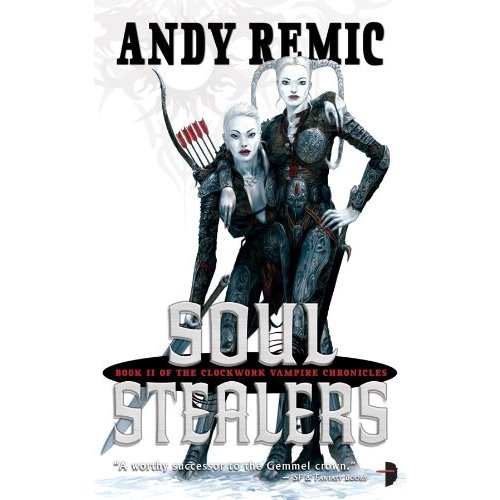
‘Soul Stealers’ – Andy Remic (Angry Robot)

I read ‘Kell’s Legend’ way back in September last year and came away feeling a little... well, I don’t know really. Remic’s bid to seize the throne sadly vacated by one David Gemmell was a book crammed full of a lot of things all driven by an undeniable power and energy; a book that slammed its foot on the accelerator and left you scrabbling to hang on in its wake. The stakes were high and we got a hero who could deal with it all accordingly; that for me though was where the book fell down in my eyes... It was all just a little too full on for me, to the point where it felt more like a Saturday morning cartoon than the story it wanted to be. And don’t get me started on the homage to Druss that felt like far more than a simple homage...
So why am I back for the second instalment then? It’s been a long old time since I last read ‘Kell’s Legend’ and I couldn’t really remember how it all went down. What I could remember though is the mother of all cliff hangers and I really wanted to see what happened next. I was also after something fun (it’s the end of the year and I’m tired...) and that was the impression I came away with after reading ‘Kell’s Legend’ so... :o)
If you read and enjoyed ‘Kell’s Legend’ then you’ll be pleased to know that ‘Soul Stealers’ offers more of the same. I’m still undecided on the whole thing though, one way or the other...

The whole world is going to hell but as far as Kell is concerned, that can all wait until he has rescued his granddaughter from kidnappers seeking to manipulate him for their own ends. The war just won’t wait though as the Army of Iron steps up its invasion from the North; harvesting human blood for the purposes of the clockwork vampire Vachine Empire. What are those purposes though? It seems that factions within the Empire, and its army, have their own plans for this monstrous harvest; plans that will drag Kell back into the game once his own quest is over. Kell is having a bad day and it’s about to get a lot worse before the day ends...

‘Soul Stealers’ was an entertaining and fun packed read but, by the time I’d finished reading, I couldn’t help but wonder ‘was that it?’ In the same way that a MacDonald’s meal will still leave me hungry (and wishing I’d forked out the extra for a nice juicy steak), ‘Soulstealers’ left me feeling empty and wishing that I’d picked up something a little more substantial.

The funny thing though is that the approach taken by Remic initially offers the book a lot to recommend it. ‘Soul Stealers’ is a ‘hack and slash bonanza’ where endless enemies line up to present themselves to Kell’s axe so he can kill them and make his way towards his objective. The ensuing scenes come across as predictable (it’s the second book in a series; you just know that Kell is going to be around for a while yet...) but you will be sticking around for the raw power in the writing. When Remic has Kell hit someone with his axe you’re left in no doubt that they’ve been hit! When you factor in the urgency of what’s going on you’re left with a story that rockets along. Except for the little intermissions between fights that is... The bickering between Kell and Saark felt, to me, like it dragged out just that little bit too far and I was left wondering if said bickering was ever going to come to anything. They both had their say and then just started saying the same things all over again... That really didn’t do anything for me.

What was interesting though is the direction that Remic seems to be taking Kell in. I’ve said before that I’m not quite comfortable with how similar Kell is to Druss the Legend and I’ll still stand by that. There’s no ‘almost’ about it, I would always rather read about an original character than one based on another character. Kell though... he proved to be a rare exception on this occasion.
While Remic still very much riffs off Druss here, this time we get to see how Druss might have turned out if he had allowed himself to go off the rails and go beserk. Instead of a good man fighting that tiny bit of bad, Kell is a self confessed bad person trying very hard to nurture that tiny flame of good inside him. Fantasy literature is full of bad people trying to do the right thing but it is rarely done on such a personal level as it is with Kell. Kell’s ferocious honesty really lays him bare in a way that you wouldn’t normally get to witness and Remic’s constant use of coarse language (maybe a little overdone, less sometimes really is more) leaves you in no doubt as to what Kell really thinks of himself. I will be back for the next book, just to see where Kell’s character goes next.

What ultimately let the book down for me though was the very ‘hack and slash bonanza’ that kept things moving to begin with. Midway through the book, it really did feel that the enemy were lining up to provide a spectacle for the reader (in terms of fights with Kell) rather than have the story move anywhere really interesting. This kind of affair would look great on the big screen but on the page it needs to be going somewhere else other than the next person to fight. The pacing fell into a rut (fight bad guy, kill bad guy, walk for a bit, fight bad guy... and repeat) and the villains of the piece lost any of semblance of evil; becoming cardboard cut-outs to be knocked down by Kell. The way that the plot dragged, because of this, turned a days read into a book that lasted longer and not for good reasons.

You know what though? Another massive cliff hanger means that I will be back for the third instalment, even though I know I’m going to encounter the same issues that I had this time round. ‘Soul Stealers’ is an entertaining read but perhaps a little too lightweight in plot to really make the impression that its language suggests that it wants to.

Seven out of Ten

Friday, 17 December 2010

‘Helion Rain’ – George Mann (Black Library)

It is always a good day when a Black Library audio book finds itself on my door mat... It doesn’t take long for me to pop it on my iPod and then I’m guaranteed a days worth of commuting where I can shut out some of the worse excesses of London travel and lose myself in the grim, dark universe of the forty first millennium. At least, that’s the way it normally goes but the latest arrival didn’t have me leaping all over it like I normally would...
The last book I read of Mann’s was ‘The Affinity Bridge’, very well received by everyone who read it. Very well received by everyone accept me that is. I won’t bore you with the details all over again (just click Here to see my review if you want) but, for me, it was a case of only half of what was promised being delivered. When I saw his name on ‘Helion Rain’ then, well... I was left wondering if I was in for more of the same. As it turned out, I shouldn’t have worried so much.

The world of Idos is in the throes of a Tyranid infestation (a ravenous species that seeks to consume everything in its path) and the 4th company of the Raven Guard Space Marines have been tasked to its defence. The opposition is nothing short of overwhelming though and an audacious plan is conceived that will hopefully buy time for the last survivors on Idos to escape. It falls to veteran Sergeant Grayvus and his squad of Raven Guard scouts to execute this plan; a plan that will involve a race against time over a landscape bombarded by the inadvertent destruction of its own moon. If that wasn’t bad enough, many varied (and deadly) sub-species of Tyranid lurk round every corner; ready to rend and flay the unwary...

I’ve got to the point, with this audio book series, where I’ve run out of original things to say about Toby Longworth’s delivery. I’ll come straight out and admit it. The fact of the matter is that he does as sterling a job as ever, certainly up to the point where I can’t imagine another Warhammer 40K audio book that doesn’t feature him in some aspect. Some of the voices may sound suspiciously similar, to those heard from earlier audio books, but it’s that gruff, hard quality to his delivery that really captures the feel of the setting. I said it last time and I’ll say it again; I’m looking forward to hearing more from Toby Longworth in the future. Emphasis is on the characters this time round, instead of background affects, and this is the right approach in a tale that is all about the characters instead of scene setting (although the steady fall of a shattered moon was a particularly nice touch in terms of giving the piece some atmosphere).

The story itself is relatively straightforward, perhaps a little too straightforward for those who after something a little more involved to chew on. There’s a mission and, although Mann does a good job of building up the tension, the outcome is never in any real doubt (although there was one point where I did wonder...) This does rob the story of some of its urgency but the real fun lies in trying to predict who will make it through to the end of the story as Mann takes great pleasure in throwing the very worst elements of a Tyranid swarm at one small band of scouts. Frequent switches in perspective show all too well how hard such an encounter can be for a full Space Marine Company and you’re left with a very clear picture of how hard it is for the scouts to complete their mission. There’s a real element of uncertainty here and, with a revealing insight into the character of Sergeant Grayvus, this was what kept my interest. Space Marines may be well nigh invulnerable but Mann goes past this and gives us a character that is far more than just a ‘hack and slash’ automaton. Grayvus has had prior experience of the Tyranids and knows just what they are capable of...

Longworth’s delivery and Mann’s climactic passages combine to give us an ending that, although not unexpected, is more than worth the price of entry. One of those endings where everything vaguely flammable is thrown at it and the end result wouldn’t look out of place on the big screen. ‘Helion Rain’ may not be a stand out entry in the Warhammer 40K audio book line but it’s a more than solid affair that fans will enjoy. Not only that but it’s also left me feeling a little happier about giving Mann’s ‘The Osiris Ritual’ a go in the near future. Look out for this one in February 2011.

Eight and a Quarter out of Ten

Thursday, 16 December 2010

‘Victorian Undead: Sherlock Holmes vs Zombies!’ – Davide Fabbri and Ian Eddington (Titan Books)

Other demands on my time are starting to force me to be a little more selective in just what zombie books I pick up for a read. For now though, it’s still a safe bet that if there is a zombie book out there that I haven’t read yet, you’ll at least find me scanning the blurb and seeing if it takes my fancy.
Before now, I’d seen individual issues of ‘Victorian Undead’ on the shelves and had resolved to give it a go when it hit trade paperback format. While I’ll admit to going off ‘classic novels featuring zombies’ as a humorous device, the gimmick has worn a little thin by now, there is still a little room to do something more serious; especially in comic books (a format that zombies transfer to very effectively, you already know the examples that I’m thinking of...) If that wasn’t enough... well, it’s ‘Sherlock Holmes and zombies’ dammit! Just those four words promise a feast of flesh eating undead, a villainous villain and problems solved with ease by that most talented of detectives; how could I not pick it up?
Having read the book, my anticipation proved to be fully justified. Shame about the artwork though...

In 1854, a strange meteor was seen above the skies of London. In its wake, the dead rose and set about the business of trying to eat the living... The ensuing twenty years saw Her Majesty’s Secret Service keep the situation under control, and under wraps, but a new threat has arisen that MI5 are powerless to prevent. That arch villain Moriarty is using zombies to further his dreams of world domination and when Moriarty’s plans are set to come to fruition there will only ever be one man who can stop him. Step forward one Sherlock Holmes! Holmes has never faced the living dead though...

‘Victorian Undead’ is a fun read and one of those reads where I found myself wishing I’d made the effort to pick the series up a lot earlier. Oh well, I got there in the end! It could have so easily gone the other way though...

It may sound like an obvious thing to say but the artwork is the first thing that you notice in a comic book and, once I’d got past the rather excellent cover pieces, I have to say that I wasn’t all that impressed with what Fabbri had to offer. The art itself does the job well enough but I found that I wasn’t all that keen on the ‘verging on the cartoonish’ zombies and the slightly bland colouring on display (which certainly didn’t do Fabbri’s work any favours). When the ‘living’ characters are rendered well, you expect the same of the undead but that wasn’t happening here. I guess that I’ve been spoilt by Charlie Adlard’s superb artwork in ‘The Walking Dead’... Like I said; while the artwork does its job, the cartoonish zombies take away some of the impact that the book wants to have in terms of pulp horror. I know there’s a good reason why the cover art is always better than what’s inside but, this time round, the gap was a little too wide to be entirely comfortable.

It’s a good job then that the story itself makes up for these shortcomings with a tale that gripped me right from the start. Of course it was going to grip me, there were zombies in it! It’s not just the zombies though; although Eddington does well in giving his readers plenty of zombie action in terms of nasty surprises and full on zombie swarms. Eddington’s Holmes is just how you would expect the great detective to be; totally in control of every situation (even that one underneath the railway line...) and with a keen analytical mind that always turns out to be at least two steps ahead of everyone else. It is fun to see Holmes work his way through the zombie mystery and it adds to the excitement that he is also a man who is not afraid to get his hands dirty when things get tough. There is plenty going on and our man Holmes is right in the thick of it!

I had some issues with the artwork but, on the whole, ‘Victorian Undead’ is a very engaging read where I just had to find out what happened at the end. It might not be up there with the best zombie comics but it will still sit proudly on the shelf.

Eight and a Quarter out of Ten

Wednesday, 15 December 2010

‘Pax Britannia: Blood Royal’ – Jonathan Green (Abaddon Books)

Christmas is a time for lots of things and, for me, one of those things is to go back and revisit a favourite author or two when the weather outside is frightful (and the fire is so delightful...) Jonathan Green sits firmly on that particular list with his ‘Pax Britannia’ series being just the right reading for this time of year. If you’re looking for something highbrow then you might just want to look somewhere else but if you’re looking for a highly entertaining read that’s a lot of fun then you’ve come to the right place! The hero is appropriately dashing and if the villains had moustaches then you can bet that they would be twirling them devilishly. The ‘Pax Britannia’ books are guaranteed to take you away from the tedium of everyday living and dump you right in the middle of a steampunk London where every shadow holds a knife and enemies of the Empire plot against the throne. You can tell that I highly recommend these books...
This brings me onto ‘Blood Royal’; a book that I’ve been saving up to read while things gently wind down towards the New Year. ‘Evolution Expects’ was clearly setting up events for future books and, while this lessened the impact of the book itself, this approach had me looking forward to seeing what happened next. I’m pleased to say that, with ‘Blood Royal’, Jonathan Green has turned in his best instalment yet.

Following the events of ‘Evolution Expects’, large chunks of London are barred to the public as they are now home to vicious insect/human hybrids that are barely contained behind makeshift barriers. That’s not going to stop Ulysses Quicksilver though! When a kidnapping goes horribly wrong and a friend’s daughter is spirited away to the locust nest in St. Paul’s Cathedral only Quicksilver can save the girl and the day. This adventure soon proves to be only a small part of something much larger though and Quicksilver once again finds himself embroiled in a plot that could have grave consequences for the Empire... What was Dr. Gallowglass working on before his untimely death and why does the trail lead to a remote region of Russia? And what is the connection to a very familiar looking killer stalking the streets of Whitechapel with a knife...?

I had my reasons for putting ‘Blood Royal’ to one side until now. I wanted to have fun with my Christmas reading this year and I knew that’s what I’d be getting with this book; it made sense to wait until now for the read. Having said all that though, I still found myself wondering I hadn’t picked this book up a lot earlier. It’s one hell of an entertaining ride and I’m not going to wait as long before picking the next book up!

Usually, when an author throws everything (he can get his hands on) at the plot it will be at the overall expense of the story. Not everything will stick, for one thing, and that inevitably leads to a fragmented book that doesn’t flow anywhere near as well as it should.
Not so with Jonathan Green and ‘Blood Royal’. Throughout the course of the book, Green really does throw everything bar the kitchen sink at the plot. Are you looking for a tale with a long dead serial killer rebuilt in cyborg form? It’s here. Were you looking for a tale of biological warfare involving vampires and werewolves? ‘Blood Royal’ comes up trumps there as well. By this point you’re probably thinking that ‘Blood Royal’ cannot possibly contain Mongol warriors riding Pterodactyls, can it? It can...
The beauty here is that everything Green throws at the plot not only sticks but sticks in such a way as to work with the plot instead of merely being decorative. What you get as a result is a plot that moves at a frantic pace whilst making complete and utter sense. Each madcap spectacle flows seamlessly into the next and I was totally caught up in the rush of trying to get to the bottom of a very mysterious murder. It’s very obvious who the murderer is but, at the same time, it’s a lot of fun to see this particular character in a new setting. I think we’ll be seeing more of him in the future...

Green’s ‘scattershot’ approach to the story also has the welcome affect of giving his readers a much more in-depth view of the world of Magna Britannia and the elements that keep the Empire running. The plot may be a little light weight and pulpy but the detail in the background offers clear evidence that this is a world that has been carefully planned and thought out. It’s a firm setting for the plot to rest on and the story benefits from being able to do its own thing without having to justify some of its wilder excesses.

Just like watching your favourite ‘Indiana Jones’ film on Christmas afternoon (‘Temple of Doom’ if you’re asking...) ‘Blood Royal’ has it all going on and at such a speed that you are almost physically compelled to keep reading. Apart from a couple of the ‘journey’ passages that is. Sometimes things just don’t happen on a long trip but that still means things can get a little on the boring side; especially when the rest of the book is such a riot of action. Tying it all together though is that dashing hero of the British Empire Ulysses Quicksilver. As always, Quicksilver is just the right kind of character to drive a plot like this with his ability to take charge of the moment and get things done. He also has a nice line in repartee and dazzling swordplay; you can’t really ask for too much more from your leading man!

‘Blood Royal’ is another thoroughly entertaining read from Green that will set the standard for the rest of the books in this series. I’m hoping for more of the same from ‘Dark Side’ and will let you know how it goes...

Nine and a Half out of Ten

Tuesday, 14 December 2010

‘Hellboy: Seed of Destruction’ – Mike Mignola & John Byrne (Dark Horse)

I’ve read bits and pieces of ‘Hellboy’, over the years, but it has always seemed to be for reasons other than the character himself. I read the ‘Ghost/Hellboy’ team-up way back in the mid nineties but that was more about my being a big fan of Ghost; Hellboy just happened to be there at the time. More recently, I found time to read ‘The Fire Wolves’; something that started out being about Hellboy but ended up being more about my checking out Tim Lebbon’s work for the first time. Hellboy even managed to force his way into my reading when he turned up in a ‘Goon’ storyline. While I’ll always be grateful to Hellboy for introducing me to the Communist Airborne Mollusk Militia (I love those guys), he again found himself playing second fiddle to an established comic book favourite of mine.
As one of the more iconic comic book characters out there, I thought it was time to get to know Hellboy properly in his natural setting. No ‘cameo spots’ or spin off novels; I wanted to take it right back to the start with the comic books that made him so popular. So that’s just what I did...

In the last days of World War Two, an increasingly desperate Nazi High Command resorted to the occult talents of one Grigori Rasputin in order to cast a spell that would save them from defeat at the hands of the Allies. The end result was a child like demonic being rescued by Allied Forces and raised in America by the US Army and the Bureau for Paranormal Research and Defence. These days Hellboy works as a Paranormal Investigator for the Bureau but the one mystery he has never solved is that of his own identity. Hellboy doesn’t mind this, as such, but when the answers finally start to present themselves... he’s going to mind very much indeed. What Rasputin began all those years ago is about to end... in a rain of frogs.

I’ve been a fan of Mignola’s cover art for a while now and it felt like a real treat to open up ‘Seed of Destruction’ and find that his work gets to grace the inner pages as well. To put it succinctly, Mignola’s art is gorgeous and I want to see more of it. Just one reason why I can see myself picking up more books in this series. The artwork complements the story perfectly with a good blend of darkness, humour and action. I also like the way that Mignola will sometimes concentrate on character detail at the expense of the background as this has the affect of letting the story flow much easier without getting bogged down in unnecessary detail. It’s not often you see artwork that just ‘is’ part of the story in the same way that Mignola’s art is here. I can’t get enough of it (especially the Lovecraftian monsters that appear from time to time).

The story itself is very much a case of setting things up to play out in future books but, at the same time, there’s also a self contained plot with a very definite ending. It’s a balancing act that plays out very well and you end up getting the best of both worlds here. One thing I would say though is that you don’t necessarily get to find out much about Hellboy’s history here, understandable really due to the way the book is structured. There were enough hints though to make me want to come back for more. Hellboy is a little on the gruff side but he’s loyal to his friends and wants to do the right thing. He also has a mystery in his past that is crying out to be solved; what’s not to come back for? The overall background setting owes a big debt to H.P. Lovecraft’s mythos but doesn’t rip it off entirely and comes across all the more fresh for it. I’m looking forward to delving into more of its secrets very soon.

As far as the plot itself goes, I could see ‘The Big Reveal’ coming quite a way off but this is more of a tale where you enjoy seeing the characters fumbling in the dark rather than having to do it yourself. While all that’s happening you get to see Hellboy go up against mutant frogmen and something that seems to be made entirely of tentacles. Hellboy may have a hand made of stone, that dishes out a mean punch, but that doesn’t stop him taking a beating at the same time. You never know quite how it’s going to turn out and that made me want to stick around all the more. It goes without saying that Mignola portrays these confrontations in fine style. There’s plenty going on (for a relatively short book) and it’s all good.

I think it’s fair to say that my first real experience of ‘Hellboy’ (in the format that made him such a big deal) was a resounding success; I think it’s also fair to say that you’ll be seeing a lot more ‘Hellboy’ here if this first volume was anything to go by...

Nine and a Half out of Ten

Friday, 10 December 2010

‘Echo City’ – Tim Lebbon (Spectra)

Tim Lebbon is one of those authors where you don’t realise that you’ve read as much of their works as you have. Odd really as he’s very good at what he does. I didn’t think I’d read much of Lebbon’s work but a quick look back through the blog proved me wrong. Here’s a guy simply brimming over with short stories and novels; I don’t want to go ‘link crazy’ but would point out ‘Fallen’ and ‘Hellboy: The Fire Wolves’ as great places to jump on board if you haven’t already.
When I realised that not only had I read more of Lebbon than I thought, but I’d really enjoyed it at the same time, my anticipation was raised all the more for his novel ‘Echo City’. The short story ‘The Deification of Dal Bamore’ had me wanting to read ‘Echo City’ anyway so I was really looking forward to cracking my copy open when it came through the post. Life always seems to conspire against my reading the books that I really want to but I got there in the end. ‘Echo City’ is as gorgeous a read as you’d expect but, at the same time, it felt as if there was something missing...

Echo City is perhaps the only bastion of humanity in existence; it’s surrounded by a vast and poisonous desert so there’s no way for its citizens to be able to tell one way or the other. A brutal theocracy holds sway over the city but the impossible arrival of a man from the desert could well blow everything wide open. It’s up to a small group of revolutionaries to protect this man against those who would protect the status quo but no-one has taken into account that he may well have plans of his own.
If this wasn’t bad enough, something is stirring in the caverns below Echo City. It is vast and it is angry. When two such threats collide, will there be anything left standing by the end...?

‘Echo City’ is a gloriously atmospheric piece that pulls you right into the various Cantons and leaves you on the wall of the city, staring out across the desert and wondering what lies beyond the horizon. It was this attention to detail that had me hooked pretty much right from the start when the first, tragic, journey is made across the desert. All kinds of questions are raised in those first few pages and the atmosphere that Lebbon creates makes it all to easy to stick around and wait for the answers to present themselves. It’s not just the upper parts of the city either that are worth visiting; the caverns underneath Echo City are full of fascinating hints of thousands of years of history that you can literally feel hanging in the air. I am a big fan of cityscapes and Echo City can sit quite proudly amongst my other favourites. It’s a place where you feel that people actually live and you can’t give much more praise than that to a city that lives only on a written page.

It’s a real shame then that the story itself rattles around in such a grand setting...

Don’t get me wrong though, the plot is a good one. Like I said, there are mysteries to be solved and they are presented in such a way that you want to stick around and see how it all plays out. How could someone survive in the desert? Just what is climbing out the catacombs beneath the city? That last question in particular is posed in just the right way to encourage interest with information being doled out in drops here and there as the book moves forward.
There isn’t an awful lot of action to be found in ‘Echo City’ but when it does kick off it’s explosive, brutal and brief. Lebbon doesn’t draw things out any longer than they need to be, emphasising the violence in terms of how quickly a person can go from being alive to being just another corpse in the gutters of Echo City. Everything fits together perfectly by the end of the book showing Lebbon as someone who really pays attention to where his plot is going.

Where the problem lies, I think, is in the fact that the city and surrounding deserts are so vast that the story is never going to be able to spread out enough to fill in all the gaps. We have a very distinct group of people on a very specific mission. This mission doesn’t really branch out at all (in fact, all of the main players find themselves feeding back in to the main plot; no matter how reluctantly) so what we have as a result is a very self-contained plot perched nervously in the midst of a setting that is far more expansive. The balance just doesn’t feel right; you need something far more epic and wide ranging to sit in such a landscape. To be fair, Lebbon goes some way towards correcting this in the climatic scenes. These scenes are appropriately powerful but I couldn’t help feeling that approach would have better employed over the whole of the novel instead of just at the end...

I also found myself wondering whether the sheer weight of history behind the plot helped contribute to a general sense of flatness right at the end. After all, if you build something up to have the weight of millennia behind it then you’ve got to be able to sign off in style, you just have to! The imbalance, that I mentioned earlier, means that you can’t quite escape from a sense of anti-climax as far as this goes. Everything comes together nicely but the setting is just too big for the ending to resonate as it should.

I’d like to see more tales from ‘Echo City’, the setting is intriguing and I’d love to see the background history fleshed out more to perhaps provide that ‘epic’ wide ranging feel that this book is missing. An engrossing story that doesn’t quite gel with a far wider ranging setting.

Eight and a Quarter out of Ten

Thursday, 9 December 2010

‘Predator: South China Sea’ – Jeff Vandermeer (Dark Horse Books)

I wouldn’t say that I’ve read a great deal of Jeff Vandermeer’s work (and some of what I have read I need to go back and re-read; it’s been a while...) but the impression I’ve been left with is that this is a guy who likes to follow his own path and tell stories of what he finds on that journey. No tapping into what’s popular here, Vandermeer stands out by seeming to deliberately go against the flow.
That made it all the more surprising then when I found out that he had written a ‘Predator’ tie-in novel a couple of years ago (yep, it can sometimes take me far too long to catch up on things). I was of course immediately curious to find out what Vandermeer made of the leap from the gloriously weird settings of ‘Finch’ and ‘City of Saints and Madmen’ to a setting that’s undeniably more commercial and mainstream. As things turned out, it was a leap made with some aplomb but also with the help of an anchor placed firmly in the weird stuff...

For those who have the money to play with, a remote jungle island in the South China Sea offers the perfect place to let off a little steam with the best in big game hunting. If there’s an animal that you ever fancied hunting, the odds are that it’s here and ready to be shot at. Now something else has arrived on the island and the hunters are about to find that the game has suddenly become a lot more deadly...
The deadliest hunter in the galaxy is on the island and on safari. In its sights is a collection of gangsters, pirates, secret agents... and a burnt out rock star. Can they put aside their own double dealing schemes to deal with a greater threat? Will the Predator only serve to advance these schemes? It’s all going down on the island and not everyone will make it out alive; not everyone will even want to...

Yet again, Jeff Vandermeer has written a novel that I couldn’t put down until I’d finished; reading his stuff is always a pleasure. This time round though it’s for entirely different reasons than normal. Vandermeer set out to write a sci-fi thriller and succeeded on all counts.

You could say though that Vandermeer was already onto a winner, before he even started, considering the material he had to work with. The ‘Predator’ franchise is successfully based on a very simple concept and it’s a concept that (on initial inspection) Vandermeer aligns very closely with what he has happening in ‘South China Sea’. It’s a tried and tested formula and one that Vandermeer doesn’t stray far from. There’s a Predator on the hunt for prey and he’s doing it in the jungle, that’s the bottom line. If you’re looking for something a little fresher in terms of plot then this may put you off initially but stick with it. The ingredients might all be the same as usual but it’s what Vandermeer does with them that eventually raises ‘South China Sea’ from being standard ‘run of the mill’ fare and turns it into something special.

First and foremost, Vandermeer works very well with what he has been given (namely, the aforementioned hunt and jungle setting). You might well see what’s coming but that’s ok, you’re meant to. Our characters don’t share that same privilege though and this is where Vandermeer injects a sense of tension that grows on the reader as the tale progresses. You can literally feel the tension growing in these people as they make their way through a relatively unfamiliar landscape whilst being stalked by an alien foe. Once you tap into that sense of tension, you have to see it through to the conclusion and this forces the plot forward at just the right pace.
It’s also worth noting that Vandermeer doesn’t just limit this tension to the human characters. The Predator is very much portrayed as being on an alien world and subject to the kind of surprises that such a newcomer would experience. Just when you think the Predator is about to walk off with it all... well, that would be telling (and some surprises shouldn’t be spoiled). It goes without saying that the resulting pyrotechnics, in various confrontations are worth sticking around for.

All of these moments are cleverly bundled up into a multi faceted and tightly controlled plot where everyone’s motivations are suspect and some only come to fruition right at the very end. There is always something going on and the human intriguing contrasts very nicely with the more straight forward ‘violence in motion’ of the Predator. This is a story that gives its readers plenty to look at as well as plenty to think about, all in equal measure.

Where ‘South China Sea’ also stands out from the pack is in the way that Vandermeer expands upon the mythos of the Predator species and, as a result, gives his readers something that’s a little broader in scope than you would expect. On the basis of the films, you might be forgiven for thinking that most Predator activity is confined to Earth. Vandermeer pulls back the curtain on a whole galaxy that is nothing more than a hunting ground for this species. I found myself rooting for the humans even more because of this. When such an activity is shown to be commonplace you can’t help but support the little guy, in the thick of it through no fault of his own.

Vandermeer really lets loose with his imagination in these scenes, none more so when one of the human party undergoes an enforced transformation themselves. While it’s beautifully written, and makes for one particularly superb fight scene, I couldn’t help but wonder whether this was one moment where Vandermeer lost that tight hold he had on the plot. While there were connections to the plot, this sub-plot felt more like an exercise in whimsy and perhaps a means for Vandermeer to reconnect with the weirdness that he enjoys delving into. As a result, we’re left with a tight plot that could perhaps be tightened more.

Despite these small failings though, you can’t really complain when the sum of ‘South China Sea’s’ parts is a such a thoroughly entertaining read. You may think you’ve seen all this before but you haven’t seen it in the hands of Jeff Vandermeer.

Nine and a Quarter out of Ten

Wednesday, 8 December 2010

‘Star Wars: Red Harvest’ – Joe Schreiber (Del Rey)

We all love Star Wars don’t we? I do. Whether it’s on the television, on Christmas afternoon, or a rainy day read the franchise is ‘comfort media’ at its warmest and most enveloping. The bottom line is that you know just what you are getting whenever you pick up a book or watch a film; a tale of good versus evil with familiar characters and some monstrous threat that either needs to be blown up with star fighters or taken apart by Luke Skywalker as he narrowly escapes falling to the Dark Side of the Force, again.
One big problem with the franchise though is that the level of ‘comfort’ is fast growing repetitive at the expense of any urgency in the plot. Certain characters have to be included and you just know that they’re not going to die. What, another galaxy threatening super-weapon? No worries, it’ll be dead and gone in the penultimate chapter...

It was a very good thing then that Joe Schreiber came along last year and gave us his tale of ‘zombies on a Star Destroyer’ with ‘Deathtroopers’. Here was a book that carried flaws, that you would expect to find in a Star Wars novel, but was still a fresh and engaging take on a long established setting. I was definitely keen to see more from Schreiber to see if he would deliver another slice of Star Wars horror. The good news is that he has, it’s zombies again but the major problem I had with ‘Deathtroopers’ isn’t here this time round and the book is all the better for it...

You would have thought that life in a Sith Academy would be dangerous enough but things have just got a lot more dangerous for the students on the planet Odacer-Faustin. The resident dark lord of the Sith has barricaded himself away and isn’t taking questions about just why violence is increasing while students are disappearing. Answers are only forthcoming when a bounty hunter arrives bearing a rare prize and a Jedi hostage; all hell is about to break lose. Those missing students were dead but they aren’t any longer. What they are is very hungry and they’ve got the force skills to catch all that they can eat. Our Jedi hostage must escape what is fast becoming a planet of the undead...

If ‘Deathtroopers’ was a haunted house in space, ‘Red Harvest’ is very much the Star Wars equivalent of a holiday camp full of teenagers being sliced and diced in a variety of ways. It’s great. With Joe Schreiber at the wheel, I can’t see ‘Star Wars Horror’ getting tired any time soon and this is a setting that can very much benefit from a healthy dose of the living dead.

My main issue with ‘Deathtroopers’ was the inclusion of a couple of very well known characters. It’s always great to see them but once they appeared you just knew they were going to make it and you could hear the sound of the tension slowly deflating as a result. Schreiber neatly sidesteps this issue by having the action take place thousands of years before the events of ‘Deathtrooper’ (which happened just before ‘A New Hope’). In this respect ‘Red Harvest’ is very much a prequel to ‘Deathtroopers’ although I’m still hoping for another book telling us what went down on the Star Destroyer before the prison barge found it. Here’s hoping...

 While it’s still a little too obvious that one character will survive, Schreiber declares open season on the rest. Anyone can get that one way ticket and Schreiber is more than happy to dole out ‘death by zombie’ in liberal measures. There are no one dimensional characters either; Schreiber takes the approach of giving everyone a little depth and you find yourself getting to know characters more and more as the book progresses. This, of course, is all part of the plan. Just when you think a character is so well drawn that they’ll be allowed to escape... they’re dead. Given the duplicitous nature of the Sith students, death can come from any direction and this uncertainty really racks up the tension in the best possible way.

Not only is Schreiber good at creating and maintaining this tension but when things kick off Schreiber makes sure that it all goes off in style. Whether it’s the attack in the canteen, the scenes in the library or the moments in the Tauntan stables (can’t say too much without spoiling things but it’s a nice little homage all on its own) Schreiber has a firm and assured hand on the energy and rhythm that’s all too evident in these passages. Things not only flow smoothly but they also flow very quickly and hold your attention for all the right reasons. The ending is signposted a little too clearly for my liking (that final surprise isn’t that surprising...) but the rest of it works well with everything coming together and providing fresh impetus for the plot to push forward.

There’s not too much to say about the zombies themselves that I haven’t already said in my review of ‘Deathtroopers’; they’re not the zombies that you would expect to see normally but as far as the Star Wars universe goes they fit in rather nicely. When you can cut up a regular zombie with a lightsaber, the only way you can even up the odds is give that zombie a lightsaber and the ability to use it. It works and it feels just like Star Wars at the same time. Can’t complain about that!

‘Red Harvest’ is a definite step up from ‘Deathtroopers’ although some of the same problems are still apparent to a certain extent. It’s entertaining enough though that you won’t care about that, I didn’t. I wouldn’t want to see zombies in all Star Wars books but I wish that all Star Wars could be written like this... Look out for 'Red Harvest' at the end of the month.

Nine and a Half out of Ten

Tuesday, 7 December 2010

‘Judge Dredd vs Aliens: Incubus’ – John Wagner, Andy Diggle & Henry Flint (Rebellion)

So I was all geared up to get all nostalgic until I found out that this story was serialised only seven years ago... Feels like a lot longer to be honest, although that could just be me feeling old today. Can you get nostalgic for things that only happened seven years ago? I don’t know.
2000AD have got good form in terms of pitting Judge Dredd up against some of the most iconic characters in comic books and film. In his career, pounding the mean streets of Mega City One, Dredd has faced off against the likes of Batman (plus associated villains) and the Predator to name but two. It was the Batman storyline that introduced me to this habit Dredd has of transcending publishers and I enjoyed it immensely. You might even see it featured here one day...
Right now though, it’s the turn of perhaps my favourite ‘Face Off’ to be featured here. According to the blurb on the back of the book... ‘In Mega City One, everyone can hear you scream!’

A shoot out, in heavy Mega City traffic, is an everyday occurrence; so are the Judges assigned to restore order at the scene. An alien life form bursting from a perp’s chest though? That’s definitely a new one... The Aliens have found a new home in Mega City One and Judges Dredd, Giant and Sanchez have to track this infestation to its source before the city itself is swarmed.
They may already be too late though as the Aliens in the warehouse and the hospital are only the merest indication of what is ready to erupt from below the Hall of Justice. Someone has a very specific plan for these Aliens and that makes them more dangerous than ever...

Before I get onto the story itself, it’s worth pointing out the great artwork on display in this collection. Carlos Ezquerra is pretty much where it’s at as far as Judge Dredd artwork is concerned with a distinctive style that just is Judge Dredd. It’s actually Henry Flint in charge of artwork duties here but I actually had to go back and check that it wasn’t Ezquerra holding the pencils, Flint is that good.
You could argue that Flint might be trying to copy Ezquerra’s work, and it is very similar here, but I for one don’t buy it. It feels like all Flint had to do here was take a small step and he would be aping Ezquerra’s work. There’s a sense of that step deliberately not being taken here and the end result is very much Flint’s work. You get a real feel for Mega City One and you also find yourself feeling the same way about the Aliens as you did in the films (although maybe not ‘Alien Resurrection’, that film was bad...) Flint has clearly got just what it takes to depict an alien attack and all its gory consequences...

The story itself is perhaps a little simplistic and linear, in plot structure, but you can’t really blame it. Not only are the Aliens the most simplistic of creatures (kill, breed and repeat...) but the Judges also have a very simplistic approach to law enforcement – solve the crime, administer justice and repeat. You can’t do an awful lot with factions like this, and the story can feel a little flat as a result, but what you can do is spice things up around the edges. This is the approach taken by Wagner and Diggle, an approach that really pays dividends.

The labyrinthine Mega City One is the ideal scene for a plot of ‘Hunt the Alien’ and the writers make full use of this. Whether it’s the confines of a hospital, the city at large or the tunnels underneath; Wagner and Diggle really bring a sense of claustrophobia to the fore that all good ‘Alien’ films have (especially the scenes with the Verminators in the hospital). When the teeth and claws come out, Wagner and Diggle have that covered as well with scenes that pit Dredd up against the ultimate killing machine. Suspend your disbelief a little and go with the flow, the action scenes are well worth it. That goes double for the scenes when the Aliens finally break into the Grand Hall of Justice; everything kicks up a gear in a fitting tribute to the film ‘Aliens’. I had trouble keeping up with the panels, everything was moving along so fast! The ending is never in doubt but, this time round, it’s all about the journey rather than its conclusion.

‘Incubus’ is never going to stretch its readers but there’s never any doubt that it will make up for this in terms of sheer entertainment. It’s one hell of a ride and perfect for fans of the ‘Alien’ franchise.

Nine out of Ten

Friday, 3 December 2010

‘Ghost Dance’ – Rebecca Levene (Abaddon Books)

Sometimes, things just click. I’ve read some of Rebecca Levene’s work, through Abaddon, and while it was entertaining enough to make me want to go back for more there was still something about it that just didn’t work for me. Issues with plot and structure to one side, there was something else indefinable that I couldn’t quite put my finger on. Then I read ‘Cold Warriors’ and it all made sense.
‘Cold Warriors’ showed me that Levene needs to be let loose on her own if we’re going to see her best work. No riffing off other people’s settings, let her run with her own idea and see where it ends; if ‘Cold Warriors’ is anything to go by you’re guaranteed a lot of fun over the course of the read. It’s taken me a little while to finally get round to the sequel but the anticipation never lessened. Levene’s ‘Cold Warriors’ was a book that hinted at a lot of potential for a sequel and for the series as a whole. Having read ‘Ghost Dance’ I’d say that the potential is still there but it hasn’t been realised, yet.

Following the events of ‘Cold Warriors’, Morgan is now with the Hermetic Division full time and struggling to come to terms with his unique status as a man with no soul. His next mission could change all of that though... A top expert on the Elizabethan alchemist John Dee has been killed by a Mossad agent with superhuman powers. Morgan must not only find out why but also seek to advance the interests of the Hermetic Division as the case unfolds.
And what a case this is. There’s an American medium employed by the CIA to investigate a cult where the members can possess animals. There’s also a very dangerous young man who is seeking to escape judgment for his crimes by uncovering the secrets of immortality. Morgan is about to get involved with both of these people in a case that’s only a small part of a much larger war between Heaven and Hell...

Rebecca Leven set up something pretty cool in ‘Cold Warriors’; a world where the war between Heaven and Hell translates almost perfectly into an urban fantasy setting full of spies of intrigue. ‘Ghost Dance’ takes this setting and proceeds to do, well... exactly the same thing as ‘Cold Warriors’. There is no doubt that this is a good thing but taking exactly the same approach again means that, in this instant, we get all the same problems that I felt held back ‘Cold Warriors’. Like I said, the potential is still there, we’re just going to have to wait for the next book to see how it pans out from there...

I don’t mind doing that though if ‘Ghost Dance’ is anything to go by; Levene has once again crafted a tale that messes with your expectations in such a way that you see everything fitting together perfectly, at the end, and wonder how you missed the convergence. It’s very cleverly done and the only loose ends left are the ones that will lead into the next book. However, these particular loose ends did contribute to another ending that felt more than a little flat... You can’t blame it really as the climactic events were always going to knock the stuffing out of whatever came next but I did find myself thinking, ‘oh, was that it...?’ It will be interesting to see if this weakness is still apparent when the books are read in the context of a larger series.

While the ending is a little lack lustre, the build up is anything but as Leven gives the plot a healthy dose of intrigue and action resulting in a tale that keeps you asking questions and then answering them in a hail of bullets or magic. As with ‘Cold Warriors’, the plot can sometimes slow down just when it needs to really step up a gear and really kick on. This time round the obstacle is Alex (our medium) and her journeys into the spirit world. I wasn’t sure if the plot slowing down in these moments was a deliberate thing or not. You could argue that it was; after all, Alex’s steps into the spirit world are very tentative (as someone fairly new to her abilities) and this was always going to slow things down from a breakneck pace to something a little more sedate. I also found myself wondering if these more descriptive passages slowed things down with their flowery language... Whether it’s one thing or the other (and I find myself thinking that it’s a little bit of both) the bottom line is that things do slow down and I found it to be to the detriment of the plot itself...

It is worth making your way through these bits though as Levene shows once again that she can write a mean climactic scene with not only a keen sense of the dramatic but also in such a way that all the main plot points are tied up nicely. Both Morgan and Alex’s characters are well developed (it’s clear that they both have motivations stretching beyond the confines of the book) and the ending offers us a chance to see them both expand further. Morgan’s character in particular is sympathetic enough that I want to be around and see where Levene’s story takes him next. It’s also worth your sticking around for the main villain of the piece. I can’t say too much without giving stuff away but, again, I found it really clever how our villain ties up several parts of the plot.

‘Ghost Dance’ exhibits the same potential as ‘Cold Warriors’ but doesn’t move beyond the flaws of its predecessor to become the story that it wants to be. It’s early days though and it’s not as if we don’t have a thoroughly entertaining story to be going on with here. You can count on my being around for the next chapter and I’m hoping that things really kick on when that instalment arrives.

Eight and a Half out of Ten

Thursday, 2 December 2010

What came home with me from the comic book store...

A bit of a quick one today as life seems to be eating into my ability to either read books or get them reviewed right now. I can’t wait for the baby to get all her own teeth... Oh well, thank goodness for comics is what I say!

‘The Walking Dead’ #79 (Kirkman & Adlard, Image Comics)


I don’t normally pick up the comics but after that final page of Volume 13 I couldn’t resist seeing what happens next. Now I’m going to have to decide whether to be patient, and wait for Volume 14, or pick up the next few issues... The ‘No Way Out’ storyline is just about to kick off and #79 is setting things up nicely for the big spectacle. It’s interesting to see various couples getting together in the face of what we all know is coming and you’re left wondering who is going to make it through to the end. If the prison storyline is anything to go by then I think we can expect a few shocks over the next couple of issues... There’s another big cliff hanger, right at the end, which has whetted my appetite for more but I did come away with the impression that Adlard was either rushed for time with the art or he was just going through the motions here. Now I have to decide whether to pick up the next issue... 9/10
 
‘Conan the Cimmerian’ #25 (Truman & Giorello, Dark Horse)


Various reasons have conspired to keep me away from ‘Conan the Cimmerian’ over the last few months; I finally get round to picking it up only to find that I’m holding the final issue... Dammit! Apparently there will be more ‘Conan’ to come from Truman and Giorello in the future; it’s a shame to see ‘Conan the Cimmerian’ come to an end but this tale of Conan’s coming to lead the Red Brotherhood is a fine way to end things in style. Truman’s storytelling is as neat and concise as ever but #25 is all about Giorello’s art as far as I’m concerned. Whether it’s Conan’s fight with the great Ape or the Red Brotherhood falling foul of the menace in the temple, Giorello’s art lends a power and vibrancy that I’m sure Howard himself would have been proud of. From what I’ve managed to read, this run of ‘Conan’ is worth picking up in trade paperback and I think that’s just what I’m going to have to do.  9.5/10

Tuesday, 30 November 2010

‘The Walking Dead Volume 13: Too Far Gone’ – Robert Kirkman/Charlie Adlard (Image Comics)

I knew it would happen, I’m slowly getting further and further behind in my attempts to watch the ‘Walking Dead’ TV show. I guess I’m just not built for TV watching these days what with everything else that’s going on; you can be sure that I’ll get there eventually though!
The important thing though is that I am now bang up to date with what’s been going on in the ‘Walking Dead’ collected volumes, all thirteen of them. You may be tired of me repeating myself but I’m not... ‘The Walking Dead’ is pretty much the best slice of zombie fiction out there right now, there’s nothing better. If you’re a zombie fan and you haven’t been reading this... well, you really need to start. Right now in fact!
Having said all that though, I found Volume 12 to be rather a flat affair that promised good things for the next volume but still left me feeling a little unsatisfied in the meantime. When things like this happen I always find myself wondering how the next volume is going to shape up. Turns out that I needn’t have worried...

Rick and his band of survivors have settled into community life but some things still don’t feel quite right, whether it’s the fear of going back outside the walls (there’s work to do out there) or the fact that certain residents either have dark secrets or are helping others to keep theirs.
Rick sees the community as perhaps the best chance anyone has to live a halfway normal life in this new world; the question is what he is prepared to do in order to maintain things... Rick used to keep the law as a police officer, now it looks like he might be taking it into his own hands, will anyone stand against him?

Yet again, Kirkman had me thinking in one direction only to turn things round and really hit me with stuff straight out of left field. Rick has been slowly going off the rails for a little while now (and who could blame him really?)  and I thought this was going to culminate in his becoming the one man who has caused him the most pain up to now. Who knows, this could still happen but not just yet. Kirkman’s ‘man on the edge’ is still clinging on despite a growing tendency to lose it in the most violent ways and it’s going to be very interesting to see if he still keeps trying to do the right thing as the series progresses further. It could still go either way but what we have in the meantime is a well fleshed out character whose decisions cannot help but reverberate in the community around him.

It’s not just Rick either, it’s very interesting to see how the others react to life in relative safety and Kirkman cleverly swaps things around so that there’s a fresh slant on people that you think you know well by now. You really get the impression that people had to dig deep and be people other than who they really were during their time in the wilderness and this becomes a fresh way of looking at established characters. People whom you thought would be cool with stepping outside those gates would suddenly much rather be safe behind closed doors...

If this wasn’t enough, we finally get to find out what’s been going on behind some of the closed doors in the community. The big confrontation was perhaps signposted a little too clearly, in Volume 12, to be a surprise but you can’t deny the power that goes with it. Kirkman does moments like these only too well and he’s on form again here with a couple of moments that made me gasp at what was happening. Special mention has to go to Charlie Adlard for showcasing the sheer intensity of physical confrontation with using any colour in the artwork at all. That lack of colour seems to push the aggression to the surface even more.
While Rick is finding his place in the community, events are happening outside that  will not only solidify his position but also hint at something huge happening in Volume 14. It’s going to be just like the prison all over again but this time with an entire city full of zombies...Kirkman knows when to leave people hanging and now I cannot wait to crack on with the story; this could be the moment when Rick falls one way or the other.

I deliberately haven’t said a lot about Charlie Adlard’s art because; well... what can I say that hasn’t been said already. Adlard has made art duties, for ‘The Walking Dead’, completely his own and you just can’t see that changing. That could be why some of the larger panels are missing a little detail, complacency or is that just common practice? I don’t know...

‘Too Far Gone’ bumps things back onto track nicely just when I was wondering what would come next and has whetted my appetite nicely for Volume 14. The long wait begins again but at least it begins on a better note than last time round...

Nine and a Quarter out of Ten

Friday, 26 November 2010

‘The Silent Land’ – Graham Joyce (Gollancz)

As much fun as high octane military sci-fi can be (and it is), you have to be careful not to overdose on the stuff. One book too many and you run the very dangerous risk of breaking out in state of the art body armour and wondering what the girl you left behind on Earth is up to... I recognise the symptoms only too well so knew when it was time to put the Black Library books down and go for something completely different instead.
And you can’t get a lot more different than Graham Joyce, fine purveyor of literature that sits in your head and messes with your brain for days after you’ve finished reading the book. That’s what happened with me when I read ‘The Tooth Fairy’ way back in 2008. Here’s a book that you can’t really say is ‘enjoyable’ as such but it’s certainly one that you can’t help but chew on and, in that sense, it is a more than satisfying read. After finishing ‘The Tooth Fairy’ I somehow never got round to reading any more of Joyce’s work and the arrival of ‘The Silent Land’ prompted me to rectify matters there! As with ‘The Tooth Fairy’, ‘The Silent Land’ isn’t an enjoyable read as such but it does give you plenty to chew on...

Zoe and Jake are on a romantic skiing break when they become caught right in the middle of an avalanche. They manage to escape relatively unhurt and return to their hotel only to find that the entire village is completely empty. Reasoning that the village has been evacuated, Zoe and Jake attempt to make their way down the mountain only to find that various routes all lead them right back to where they started. Ensuing hallucinations and weird occurrences lead them to believe that perhaps they never survived the avalanche but if this is the case, what happens next...?

‘The Silent Land’ is a very short tale (seriously, a ‘blink and you might just miss it’ two hundred and forty eight pages long) of true love that is put to its ultimate test. It had me gripped throughout and there may have even been a couple of moments where I had to pretend that there wasn’t a tear in my eye. What the book also was though was a book with an ending that I saw coming from a mile off, possibly far earlier than it should have been apparent.

Now, part of me wonders if the ending wasn’t so much the point as it was the interactions and changing relationship between Zoe and Jake as they make sense of their surroundings. The growing sense of inevitability, that the clearly signposted ending brings, does push Zoe and Jake’s relationship to it limits and in interesting new directions from time to time. By leaving the ending in no doubt, you can argue that Joyce leaves his readers free to concentrate on the really cool stuff instead. It might just be me though but what I found was that this foreshadowing really took the sting out of the tale for me; I’m one of those folks who doesn’t like to have the ‘big reveal’ sprung on them right until the end (or at the very least, just before) so to know what’s looming on the horizon did make me wonder why I was continuing to read at times...

That reason became very apparent early on though. Like I said, Joyce leaves his readers free to concentrate on the cool stuff and there is more than enough of this to keep a reader like me very happy indeed.

While Joyce may leave the ending in no doubt, all the clues that go towards that ending are immediately engaging and very mysterious, you’ll know how it all ends but what you’ll spend the time on is working out how all these clues fit together in the final puzzle. That what was happened with me as I spent time musing over things like how only Zoe could hear her mobile phone ringing... When the answers come, everything slides together perfectly and it all makes sense. Perhaps the delivery of that final revelation comes across as a little flat but, again, that’s almost beside the point. It’s all about Zoe and Jake and how they come to terms with their situation.

Zoe and Jake’s relationship is the focal point of the story and it is refreshing to see the direction that it travels in over the course of the book. Instead of moving their relationship from one point to another, Joyce reflects how relationships play out in real life by throwing Zoe and Jake’s relationship hither and yon whilst battering it with various revelations. The more things change the more they stay the same though and you are left in no doubt as to how these two people really feel about each other. This approach lends a real sense of loss to those final pages; a feeling that stayed with me for a long time afterwards.

‘The Silent Land’ is a novel that is perhaps signposted a little too clearly to be really effective but makes up for this in a number of smaller (but still important) ways. It’s certainly a novel that has left me eager not to miss out on any of Joyce’s work in the future.

Eight and a Half out of Ten

Thursday, 25 November 2010

‘Dead Men Walking’ – Steve Lyons (Black Library)

Like me, if you’re relatively new to the Black Library range then you’d be forgiven for thinking that the ‘Imperial Guard’ line consists solely of Dan Abnett’s ‘Gaunt’s Ghosts’ books. After all, these are the books that seem to get all the accolades for telling it just how it is for the mortal Guardsmen on the front lines of the far future. However, the regiments of the Imperial Guard number in the hundreds of thousands (at least) and this is reflected in a number of other books that might just fly under your radar if you’re not careful. The authors of these books might have paid the price for not developing their work into a series but give their books a go anyway. In particular, I’ll recommend Aaron Dembski-Bowden’s ‘Cadian Blood’ and Rob Sanders’ ‘Redemption Corps’ as good places to get started.

Steve Lyons’ ‘Ice Guard’ was one of the first ‘Imperial Guard’ novels that I read for the blog and was enough for me to keep an eye open for more of his work. Unfortunately for me, the next thing of his that I picked up was the audio book ‘Waiting Death’ and that didn’t work for me at all. With the scores evenly balanced, Lyons’ latest book ‘Dead Men Walking’ was always going to tip the scales one way or the other...

In the Imperium of Mankind the danger doesn’t always come from the stars; sometimes it lays waiting right beneath your feet... The workers on an Imperial mining planet have uncovered something that should have been left well buried. Now the necrons walk the planet once again and an ill equipped Planetary Defence Force is being massacred almost as a matter of course. The call for help goes out but the arrival of four regiments of the Death Korps of Krieg may not be the salvation the beleaguered populace are after.
The Death Korps of Krieg are perhaps the most brutal of the Imperial Guard regiments, prepared to sacrifice anything to kill what’s in front of them in the name of the Emperor. Anything else is of secondary importance, an outlook that lends unhealthy comparisons to the necrons that they are fighting. In the face of astronomical casualties, the Death Korps are resolute in their zeal to do the Emperor’s bidding. Will there be anything left after the guns finally fall silent?

If there’s one thing that you take away from Warhammer 40K fiction, it’s the sobering realisation that war is a game that no-one ever really wins (unless you’re playing the WH40K game that is, you can win that). In this universe, warfare is merely about staving off mankind’s inevitable destruction at the hands of various alien races for as long as possible. Any kind of victory is determined purely in terms of whether the enemy is still standing at the end of an engagement, never in terms of the consequences for the civilian populace. Lyons totally gets this and has written a novel that reflects it almost perfectly. ‘Dead Men Walking’ is a dark and gloomy novel that asks the question of whether you can really die a hero when, to all intents and purposes, you already see yourself as dead. The answer very much depends on who you are asking here and the results throw up some interesting contrasts between the Imperial Guard and the citizens they are tasked to protect. Gunthar Soreson’s tale is most interesting in this respect and Lyons uses it bring the effects of the war into the sharpest relief. I wasn’t sure about Arex’ narrative though. While I get how she influenced the path of other characters her story didn’t pack the same punch as others and lessened the overall impact of the novel as a whole.

‘Dead Men Walking’ charts the gradual fall of an Imperial world at the hands of a particularly insidious menace. To be fair, all of the xenos races in the Warhammer universe are particularly insidious but there is something about the necrons that is especially chilling. These metal warriors display no emotion whatsoever (even the Tyranids have a form of animal rage) and are absolutely remorseless in their approach to warfare; they just won’t stop until you are dead. Lyons captures this very well, simply by sending by piling loads of necrons together and shelling them with Imperial guns.

On the other side of the equation is the Death Korps, an army of men with nothing else on their mind than selling their lives to right an ancient wrong their ancestors committed. The gas masks they wear mean they show no emotion whatsoever and they are absolutely remorseless in their approach to warfare; they just won’t stop until you are dead. Lyons captures this very well, simply by lining the Death Korps up in neat ranks and marching them into range of the necron gauss weaponry.

You can see where I’m going here. Lyons is essentially showing us that there really isn’t a lot of difference between the two opposing forces; both want to win and both see the surrounding area (and its populace) as expendable materiel for exploitation. This raises some interesting points where certain characters finally begin to get an idea of the regime that they live under. It’s a shame that it comes too late to make any real difference... It also helps foster a real sense of empathy for the Death Korps themselves once you realise what has made them this way. You’ve got to feel a little sorry for them.
What I would say is that an interesting basis for comparison is sacrificed in the name of lining these opposing parties up and having them shoot at each other. Don’t get me wrong, the battle sequences are suitably intense (neither side will back down, only one can walk away at the end), and the urgency of the plot demands resolution over introspection, but it just felt that there was an opportunity missed to dig a little deeper. There’s plenty to chew on but I found myself waiting for a second course that never arrived...

Maybe that was intended though. ‘Dead Men Walking’ charts the downward spiral of an Imperial planet under attack and not only is that the main order of the day but it’s done very methodically and very well. From the first hints of an alien presence on the planet to Gunthar’s final decision at the end of; everything fits together perfectly and sends the plot rolling forwards to its inevitable conclusion. ‘Inevitable’ isn’t such a bad thing either, not when it’s written so well. If you’re a fan of the Imperial Guard, or just military sci-fi in general, then ‘Dead Men Walking’ deserves a look.

Nine and a Quarter out of Ten

Wednesday, 24 November 2010

‘Firedrake’ – Nick Kyme (Black Library)

I told you it would probably be a ‘Black Library Week’ on the blog didn’t I...? The last couple of weeks have seen me realise that although it’s always good to test yourself on something that you wouldn’t normally read, sometimes all you want is to have a little fun with a book. If you don’t enjoy what you’re reading then you have to ask yourself what the point is really...
This realization invariably leads me back to the Black Library ‘Warhammer 40,000’ line; books that are never anything less than entertaining and are generally very well written. When the nights start to draw in and the daily commute becomes more and more of a grind, these books take care of it all.
I read Nick Kyme’s ‘Salamander’ way back in August last year and, despite a couple of niggles, enjoy it immensely; certainly enough to have the sequel firmly in my sights when it was published. It took me a little while longer to actually get round to reading it and, despite some new niggles, enjoyed this one immensely too...

The people of Nocturne have had a long and bitter relationship with Dark Eldar slavers, an enmity that stretches back millennia. When the Dark Eldar are on the prowl, the Salamander Space Marines can always be counted upon to rise to the challenge and strike back hard. Other parties know this and this is how Salamander Chaplain Elysius comes to fall into enemy hands... That the Salamanders will mount a rescue attempt is beyond any doubt but there is far more at stake than the life of the Chaplain. The armour of Elysius holds secrets that could well shed new light on the eventual fate of Nocturne itself; this rescue attempt is a race against time in more than one sense.
On another planet entirely, newly inducted Librarian Dak’ir accompanies his mentor Pyriel on a mission to ascertain the intentions of their enemies; perhaps more important is the fact that they must determine just exactly what Da’kir’s place in prophecy is. Salvation or damnation is promised but Dak’ir could easily be either...

‘Firedrake’ is the second book in the ‘Tome of Fire’ trilogy so it stands to reason that this isn’t one you can jump straight into (check out ‘Salamander’ first, it’s worth it). With over a year having passed since I read the first book I found this to be even more the case. Main characters aside, I found that it took me a little while to get my head around who was who again; it might just be me but the ‘Tomes of Fire’ trilogy could well be the first Black Library series to require its own dramatis personae list...
Having said all that though, I think that a large part of what made ‘Firedrake’ initially inaccessible to me was Kyme’s approach to the timeline of events. Space Marines are notoriously long lived and their idea of something that happened recently can be anything upwards of fifty years ago. This led to some massive jumps back into the past (to explore prior events) that weren’t particularly well signposted at the time. Everything ties together very neatly at the end but again, it’s a bit of a slog to get your head around it initially. At least, it was for me.

What I would say though is to stick with it (if you’ve already read ‘Salamander’ then I guess that’s what you’ll be doing anyway) as ‘Firedrake’ does come up with the goods while setting things up nicely for the third instalment.

That’s not to say that it’s all plain sailing though. The book is split into two separate strands with Dak’ir and Pyriel’s quest for knowledge running alongside the mission to rescue Elysius. Dak’ir’s plot in particular suffers from the inaccessibility that I mentioned earlier with Kyme’s approach (regarding timescale) taking a little while to properly ‘click’ and dovetail with the rest of the book. Dak’ir’s plot is also set up to be resolved in the final book and is perhaps cut a little too short right at the end of this one. What you’re left with is a character who has taken half a book to answer some smaller questions but not the big one. While I’m sure that ‘Nocturne’ (the third book in the trilogy) will tie things up, we’re left with something that feels like it should be a cliffhanger but seems to go out with a little whimper instead...

Not to worry though, not only is there some nice character development on Dak’ir’s part (to balance things out) but the ‘rescue Elysius’ side plot is well worth the price of entry. Despite being asked to just accept that some things happen off stage (I’m still not 100% au fait with the setting but could the Dark Eldar really capture Elysius as easily as that...?) this plot runs very smoothly, throwing up moments of real spectacle and excitement and properly introducing us to the antagonists in such a way that a real sense of tension is apparent and I was left wanting to see how it all plays out in the final instalment. The world of the Dark Eldar is gloriously... erm... dark and the perfect setting for a real game of ‘cat and mouse’ to play out with all its dead ends and seemingly hopeless confrontations. There are a lot of these and the pace rockets along as a result.

In ‘Salamander’, the Space Marine Tsu’gan was in danger of becoming seriously one dimensional as he was locked into a downward spiral of self hate that didn’t seem to be going anywhere relevant. Perhaps one of the best things that Kyme does is to spend more time working out what makes Tsu’gan tick and then placing him in situations where his character is forced to develop. As a result, Tsu’Gan’s character is fascinating to follow and is perhaps the main reason why I will be picking up ‘Nocturne’ when it is released (late next year I think). There is more to him than you would think...

I have a suspicion that after having read ‘Nocturne’ I will be forced to revise my opinion of ‘Firedrake’ (as part of a larger story rather than a book on its own). ‘Firedrake’ is the ‘middle book’ in a trilogy and falls foul of some of the associated pitfalls but there is a lot to recommend it at the same time. If you’re reading this series, there’s no reason to put it down just yet and every reason to carry on...

Eight and a Quarter out of Ten